History clock widget for Android
Every minute has a history
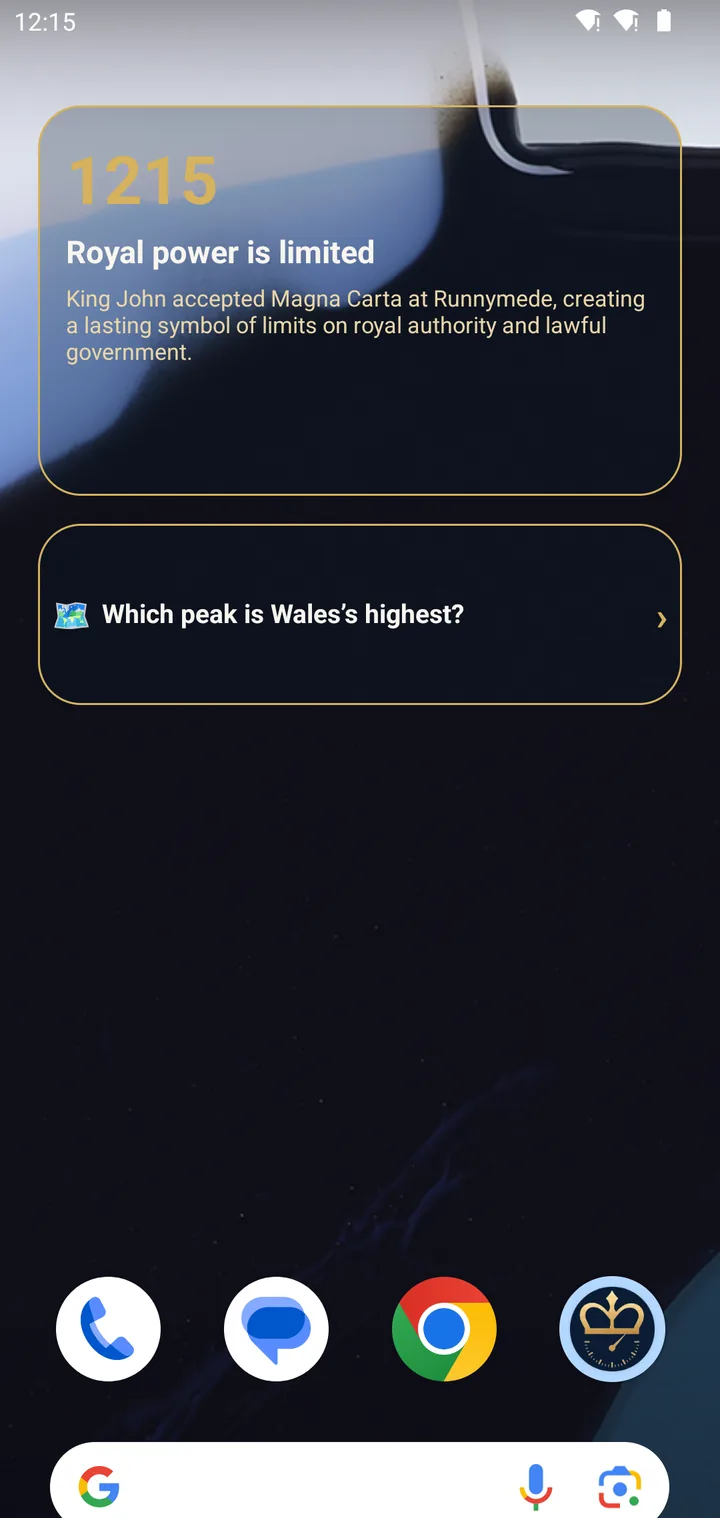
CrownMinute is a free Android widget that reads your clock as a year of English history: 12:15 is 1215, Magna Carta; 19:14 is 1914, Britain enters the First World War.
 Free · No ads · Works offline
How the clock becomes a year
MOST OF THE DAY
00:01 – 20:26
The time reads straight as a year: 16:05 is 1605, the Gunpowder Plot. A minute with no event of its own keeps the most recent one.
LATE EVENING
20:27 – 23:50
Years like 1066 or 1588 can't be a time, since no hour has 66 minutes. Each of these 204 years gets its own minute, newest first.
BEFORE MIDNIGHT
23:51 – 00:00
The BCE era, from the first footprints of early humans at Happisburgh to Julius Caesar's expeditions.
Every minute of the day
All 586 minutes that have their own year, with all 685 events and a one-line summary of each.
Daytime: the time is the year
From 00:01 to 20:26 most times read directly as a year: 16:05 is 1605, 19:14 is 1914. A minute with no event of its own keeps the most recent one before it, so the widget is never empty. Where a year has more than one event, the widget picks one of them.
00:00 – 00:59
- 1
Tasciovanus rules the Catuvellauni from Verlamion. Around 1 CE, at the turn of the era, Tasciovanus, king of the Catuvellauni, ruled from Verlamion beside modern St Albans and struck coins bearing his name and the town's.
- 10
Cunobelinus makes Camulodunum his capital. Around 10 CE, Cunobelinus succeeded his father Tasciovanus as king of the Catuvellauni and made Camulodunum, modern Colchester, his capital and the seat of his mint.
- 40
Caligula halts at the Channel. In 40 CE, Emperor Caligula assembled forces on the Channel coast for an invasion of Britain that never sailed.
- 42
Caratacus and Togodumnus press west on the Atrebates. Around 42 CE, after the death of their father Cunobelinus, Caratacus and his brother Togodumnus were pushing Catuvellaunian power west against the pro-Roman Atrebates, whose exiled king Verica turned to the emperor Claudius.
- 43
Romans win the Battle of the Medway. In 43 CE, Roman forces under Aulus Plautius defeated the Britons in a two-day battle at a river crossing generally identified as the Medway in Kent.
Claudius enters Camulodunum. In 43 CE, Emperor Claudius came to Britain in person and captured Camulodunum, modern Colchester, the capital of the late British king Cunobelinus.
Roman invasion of Britain begins. In 43 CE, Emperor Claudius ordered a major Roman invasion of Britain, beginning nearly four centuries of Roman rule.
- 47
Londinium begins to grow. By about 47 CE, the Romans had founded Londinium on the Thames, where a timber drain of 47–48 CE is the earliest securely dated structure yet found.
Roman roads and the Fosse Way frontier take shape. By 47 CE, the Romans had reached a temporary frontier in Britain, along which the Fosse Way was probably laid as a military road.
- 49
Camulodunum becomes a Roman colonia. In 49 CE, the Romans planted a colonia of retired soldiers at Camulodunum, modern Colchester, the old native capital.
- 51
Caratacus is defeated and captured. In 51 CE, British resistance leader Caratacus was defeated in battle and handed to Rome by Queen Cartimandua.
01:00 – 01:59
- 105
Vindolanda tablets record frontier life. In the late first and early second centuries CE, soldiers, officers and their families at the Roman fort of Vindolanda wrote letters and records in ink on thin wooden tablets.
- 108
Trajan is honoured at the legionary fortress of York. In 107 or 108 CE, the Ninth Legion Hispana recorded building work at the legionary fortress of York in the name of the emperor Trajan, on a stone tablet found near the site of the fortress's south-east gate.
- 122
Hadrian orders the building of Hadrian's Wall. In 122 CE, Emperor Hadrian ordered a frontier wall across northern England, creating one of Roman Britain's most famous monuments.
Hadrian visits Britain. In 122 CE, Emperor Hadrian visited Britain during a tour of the empire's provinces to inspect troops and frontier defences.
- 124
Hadrian's Wall becomes a working frontier. During the 120s CE, while Hadrian's Wall was being built, its plan grew from a line of milecastles and turrets into a frontier with forts on the Wall itself and a great earthwork, the Vallum, behind it.
- 130
Roman towns, villas, roads, and baths expand. From the second century CE, as Hadrian and his successors consolidated Roman gains, country houses and farms became common across the romanised parts of Britain, alongside Roman-style towns.
- 140
Aquae Sulis grows around Roman baths. By the second century CE, Aquae Sulis, modern Bath, had grown into a major Roman temple and bathing centre around its sacred hot spring.
- 142
Antoninus Pius begins the Antonine Wall. Around 142 CE, on the orders of Emperor Antoninus Pius, Roman forces began building the Antonine Wall across central Scotland, north of Hadrian's Wall.
- 150
Ptolemy maps Britain. Around 150 CE, the geographer Ptolemy recorded the places and peoples of Britain in his Geography, fixing the island on the ancient world map.
02:00 – 02:59
- 200
Roman London gets its city wall. Around 200 CE, the people of Londinium built a stone wall about 2.5 miles long around the landward side of their city.
- 208
Septimius Severus campaigns in Britain. In 208 CE, Emperor Septimius Severus came to Britain with his sons Caracalla and Geta to conquer the parts of the island outside Roman rule.
- 209
The northern frontier is repaired under Severus. Around the time of Septimius Severus's British campaigns of 208–211 CE, Hadrian's Wall was repaired and its frontier defences reorganised.
- 211
Septimius Severus dies at Eboracum. In 211 CE, the emperor Septimius Severus died at Eboracum, modern York, during his campaigns in northern Britain.
- 212
Caracalla extends Roman citizenship across the empire. In 212 CE, Emperor Caracalla granted Roman citizenship to nearly all the free inhabitants of the empire, including people in Roman Britain.
- 217
Macrinus, the first emperor who was not a senator. In 217 CE, three days after the murder of Caracalla, his praetorian prefect Macrinus was proclaimed emperor by the army, the first man to rule the empire without having achieved senatorial rank.
- 221
Elagabalus is honoured at Chesters. In 221 CE, on 30 October, the cavalry at Chesters fort on Hadrian's Wall dedicated a restored building with an inscription naming Elagabalus as priest of the Sun-god whose name he bore.
- 222
Severus Alexander's governor builds on the frontier. In 222 CE, the first year of Severus Alexander's reign, his governor Marius Valerianus oversaw new works at northern forts, bringing a water supply to South Shields and completing a cavalry drill-hall at Netherby.
- 235
The third-century crisis reaches Roman Britain. From 235 CE, the Roman Empire entered half a century of invasions, civil wars, short-lived emperors and collapsing coinage that also drew in Britain.
- 237
Maximinus Thrax is honoured on Hadrian's Wall. In 237 CE, soldiers at Carrawburgh fort on Hadrian's Wall recorded a building in the name of the emperor Maximinus Thrax and his son Maximus, styling both conquerors of Germany, Dacia and Sarmatia.
- 238
Gordian I is proclaimed emperor in Africa. In 238 CE, Gordian I, an elderly senator who had probably governed the province of Lower Britain some twenty years earlier, was proclaimed emperor in Africa and died within a few weeks.
Pupienus and Balbinus are chosen by the Senate. In 238 CE, the Senate chose the 74-year-old soldier Pupienus to rule jointly with Balbinus against the emperor Maximinus, but within months the Praetorian Guard killed them both.
- 242
Gordian III is honoured by army units in Britain. In 242 CE, a cavalry regiment at Old Carlisle that bore the emperor's name dedicated an altar to Jupiter for the welfare of Gordian III, his wife Tranquillina and their whole household.
- 247
Philip the Arab and his son are named on British milestones. In 247 CE, a milestone beside the Roman road near Old Carlisle named the emperor Philip the Arab together with his son Philip, then Caesar and consul.
- 250
Alban becomes the first British martyr. One proposed dating places the execution of Alban, the first Christian martyr of Britain, at Verulamium around the mid-third century.
Decius's road repairs reach Britain. Between 250 and the spring of 251 CE, a milestone on the Roman road through Castleford named the emperor Decius and his son Herennius Etruscus, part of an empire-wide programme of road repairs under Decius.
- 252
Trebonianus Gallus and Volusian are honoured in Britain. In 252 CE, a centurion at Housesteads set up an altar to Mithras dated by the consulship of the emperors Trebonianus Gallus and his son Volusian.
- 253
Aemilianus seizes the throne for three months. In 253 CE, Aemilianus, commander of the army of Moesia, rebelled against Trebonianus Gallus and became emperor, but he was killed by his own troops within three months.
- 255
Valerian's name is set on rebuilt barracks at Caerleon. Around 255–260 CE, under Valerian and his son Gallienus, the Second Legion Augusta rebuilt barrack blocks in its fortress at Caerleon and recorded the work in the emperors' names.
- 258
Gallienus rules the West beside his father. In 258 CE, Gallienus, who governed the western provinces while his father Valerian fought in the East, defeated the Alemanni at Milan; in these years a unit of Moors in Britain styled itself “Valerian's and Gallienus' Own”.
03:00 – 03:59
- 301
Diocletian's price edict lists British goods. In 301 CE, Diocletian's Edict on Maximum Prices set price ceilings across the Roman Empire, and its list includes British cloth products.
- 306
Constantine is proclaimed emperor at York. In 306 CE, Constantine was proclaimed emperor by the army at Eboracum, modern York, after the death of his father Constantius.
Constantius Chlorus dies at Eboracum. In 306 CE, Emperor Constantius Chlorus died at Eboracum, modern York, after a campaign in northern Britain.
- 313
Christianity is legalised in the Roman Empire. In 313 CE, the emperors Constantine I and Licinius agreed the Edict of Milan, which gave Christians throughout the Roman Empire, including Britain, freedom of worship.
- 314
Roman Britain is reorganised into provinces. By the fourth century CE, Roman Britain was divided into four provinces, each with its own governor, under a single vice-governor of “the Britains”.
British bishops attend the Council of Arles. In 314 CE, bishops from Britain attended the Council of Arles in Gaul, showing that Roman Britain had an organised church.
- 320
Water Newton Treasure shows Christian worship. Around the fourth century CE, Christians at the Roman town of Durobrivae, now Water Newton in Cambridgeshire, used silver vessels and plaques in their worship, the earliest group of Christian liturgical silver yet found in the Roman Empire.
- 337
Constantine II becomes ruler of Britain. In 337 CE, after the death of Constantine the Great, his son Constantine II took the title Augustus and became ruler of Britain, Gaul and Spain.
- 343
Emperor Constans visits Britain. In 343 CE, Emperor Constans visited Britain, the last legitimate Roman emperor to come to the island.
- 350
Lullingstone Villa shows Christian life. Around the middle of the fourth century CE, the owners of Lullingstone Roman Villa in Kent created a house-church decorated with Christian wall paintings.
Britain is drawn into Magnentius's revolt. In 350 CE, the army commander Magnentius seized power in the western Roman Empire, drawing Britain into the civil war that followed.
- 353
Constantius II sends Paulus “the Chain” to Britain. In 353 CE, after the death of the usurper Magnentius left Constantius II sole emperor, he sent the state secretary Paulus to Britain to arrest Magnentius's supporters, and the purge that followed fell on many innocent people.
- 359
British grain feeds the Rhine frontier. In 359, Julian, then Caesar in the West and the future emperor, rebuilt a fleet of hundreds of ships to carry British grain to the Roman Rhine frontier.
04:00 – 04:59
- 401
Roman troops are withdrawn from Britain. In 401 CE, when Alaric's Visigoths invaded Italy, Stilicho summoned troops from Britain to help defend it.
- 402
The last Roman coin supply reaches Britain. Around 402 CE, the regular supply of new Roman coins to Britain came to an end, one of the clearest signs of the end of Roman Britain.
- 405
Irish and Saxon raids intensify. Around the early fifth century CE, raids by the Irish (Scots), Picts and Saxons put growing pressure on a Roman Britain whose garrison was shrinking.
- 406
Marcus is proclaimed emperor by the army in Britain. In 406 CE, the Roman troops in Britain revolted and proclaimed one Marcus emperor, but soon killed him when he did not do as they wished.
- 407
Constantine III is proclaimed in Britain. In 407 CE, the Roman army in Britain proclaimed Constantine III emperor, after first raising and killing two other rulers of its own choosing.
Constantine III takes troops to Gaul. In 407 CE, the newly proclaimed emperor Constantine III crossed from Britain to Gaul with troops from the island, leaving Britain more weakly defended.
Gratian is killed after four months as emperor in Britain. In 407 CE, Gratian, a townsman of Britain whom the army there had made emperor after killing Marcus, was himself killed after four months, and the soldiers chose Constantine III in his place.
- 409
Britain rejects Roman officials. Around 409 CE, according to the Greek historian Zosimus, the Britons broke away from Roman rule and took up arms to defend their cities themselves.
- 410
Honorius tells British cities to defend themselves. In 410 CE, Emperor Honorius is traditionally said to have told British cities to look to their own defence.
Post-Roman local rule begins. In 410 CE, by the usual reading of Zosimus, Emperor Honorius left the cities of Britain to provide for their own defence, and local communities had to govern Britain without Roman imperial officials.
- 411
Constantine III falls and Roman rule fades. In 411, the usurper Constantine III, proclaimed by the army in Britain, was defeated and executed, and Roman government never returned to the island.
- 429
The Alleluia Victory tradition is recorded. Around 429 CE, tradition says, Germanus of Auxerre led the Britons to a bloodless “Alleluia Victory” over raiding Saxons and Picts.
Germanus of Auxerre visits Britain. In 429 CE, Germanus, bishop of Auxerre, came to Britain with Lupus of Troyes to combat the Pelagian heresy.
- 430
Vortigern's Saxon invitation tradition begins. Around 430 CE, by one modern estimate, the British ruler Vortigern invited Saxon warriors into Britain to defend it against northern raiders, according to later writers.
- 446
The Groans of the Britons appeal is made. Around 446 CE, the Britons sent a vain appeal for help to the Roman general Aetius, remembered as the “Groans of the Britons”.
- 449
Hengist and Horsa arrive by tradition. By tradition, in 449 CE the brothers Hengist and Horsa landed in Britain at Vortigern's invitation, and Hengist became the legendary founder of the royal line of Kent.
- 455
Battle of Aylesford tradition. By tradition, in 455 CE Hengist and Horsa fought the British king Vortigern at Aegelsthrep, possibly Aylesford in Kent, and Horsa was killed there.
- 457
Battle of Crayford tradition. By tradition, in 457 CE Hengist and his son Æsc defeated the Britons at Crayford, and the Britons abandoned Kent.
05:00 – 05:59
- 508
Cerdic fights Natanleod by tradition. By tradition, in 508 CE Cerdic and Cynric defeated and killed a British king named Natanleod.
- 514
Stuf and Wihtgar arrive by tradition. By tradition, in 514 CE Stuf and Wihtgar came to Britain with the West Saxons and fought the Britons, and they later received the Isle of Wight.
- 516
The Britons hold the line at Badon. The Annales Cambriae place the battle of Badon, a famous British victory that slowed the Anglo-Saxon advance, in 516.
- 519
Cerdic takes the West Saxon kingship by tradition. By tradition, in 519 CE Cerdic and Cynric took the kingship of the West Saxons, the starting point of the royal line of Wessex.
- 530
The Isle of Wight is taken by tradition. By tradition, in 530 CE Cerdic and Cynric took the Isle of Wight and killed many of its men.
- 534
Cerdic dies and Cynric succeeds by tradition. By tradition, Cerdic, the first king of the West Saxons, died in 534 CE and Cynric succeeded him.
- 540
Gildas writes about Britain's ruin. Around the middle of the sixth century, the British monk Gildas wrote De Excidio et Conquestu Britanniae, a fierce moral account of Britain's ruin.
- 547
Ida becomes king of Bernicia. In 547 CE, according to the Anglo-Saxon Chronicle, Ida began his reign as the first recorded king of Bernicia, an Anglian kingdom in the far north of England.
- 552
Cynric fights at Sarum by tradition. In 552 CE, according to the Anglo-Saxon Chronicle, Cynric of the West Saxons fought the Britons at Searobyrg, the hillfort now called Old Sarum, and put them to flight.
- 556
Cynric fights at Beranburh by tradition. In 556 CE, according to the Anglo-Saxon Chronicle, Cynric and his son Ceawlin fought the Britons at Beranbyrg, probably the hillfort of Barbury Castle.
06:00 – 06:59
- 600
Æthelberht's law code is written. Around 600 CE, Æthelberht of Kent issued the earliest surviving English law code.
- 601
Gregory sends a second mission to England. In 601 CE, Pope Gregory I sent a second group of missionaries to Augustine in Kent, with books, church goods and letters of guidance.
- 603
Battle of Degsastan. In 603 CE, Æthelfrith, king of the Northumbrians, defeated Áedán, king of the Scots of Dál Riata, at Degsastan.
- 604
London and Rochester receive bishops. In 604 CE, Augustine made Mellitus bishop of London and Justus bishop of Rochester.
- 616
Æthelberht of Kent dies. In 616 CE, by Bede's dating, Æthelberht of Kent died, and the young English church faced a pagan reaction.
- 617
Edwin becomes king of Northumbria. Around 617 CE, Edwin of Deira became king of Northumbria after Rædwald of East Anglia defeated and killed King Æthelfrith.
- 625
The Sutton Hoo royal burial is made. Around 625 CE, a great ship burial, probably for a king, was made at Sutton Hoo in East Anglia.
- 627
Edwin is baptised at York. In 627 CE, King Edwin of Northumbria was baptised at York by the missionary Paulinus.
- 633
Edwin is killed at Hatfield Chase. In 633 CE, by Bede's dating, Edwin of Northumbria was killed in battle at Hatfield Chase, throwing Northumbria into crisis.
- 634
Oswald becomes king of Northumbria. In 634 CE, Oswald returned from exile and became king of Northumbria after defeating Cadwallon at Heavenfield.
- 635
Aidan founds Lindisfarne. In 635 CE, the Irish monk Aidan founded the monastery of Lindisfarne off the Northumbrian coast.
Cynegils is baptised at Dorchester. In 635 CE, King Cynegils of the West Saxons was baptised by Bishop Birinus at Dorchester, with King Oswald of Northumbria as his sponsor.
- 642
Oswald is killed at Maserfield. In 642 CE, Oswald of Northumbria was killed in battle against Penda of Mercia at Maserfield.
- 645
Cenwalh is driven out by Penda. In 645 CE, King Penda of Mercia drove King Cenwalh out of Wessex after Cenwalh had put away his wife, Penda's sister.
- 653
Peada brings Christianity to Middle Anglia. In 653, Peada, son of the pagan king Penda, was baptised and brought Christian missionaries into Middle Anglia.
- 655
Penda is killed at the Winwaed. In 655 CE, Penda of Mercia was defeated and killed by Oswiu of Northumbria at the Battle of the Winwaed.
- 657
Hilda founds the abbey at Whitby. In 657, Abbess Hilda founded the monastery of Streoneshalh, later Whitby, soon one of the great centres of English learning.
07:00 – 07:59
- 704
Æthelred of Mercia becomes a monk. In 704 CE, King Æthelred of Mercia gave up his throne and became a monk after about thirty years as king.
- 710
Ine fights Geraint of Dumnonia. In 710 CE, Ine of Wessex fought Geraint, king of the Britons of Dumnonia, as Wessex pushed westwards.
- 715
The Lindisfarne Gospels are made. Around 715, the monk Eadfrith of Lindisfarne created the illuminated Gospel book that remains a treasure of early English art.
- 716
Æthelbald becomes king of Mercia. In 716 CE, Æthelbald became king of Mercia and went on to dominate the English kingdoms south of the Humber.
- 725
Bede teaches Europe to count the years. In 725, Bede completed The Reckoning of Time, the work that spread dating years from the birth of Christ.
- 726
Æthelheard succeeds Ine in Wessex. Around 726 CE, Æthelheard became king of the West Saxons when Ine gave up the throne and went to Rome, but he had to fight a rival for the kingdom.
- 731
Bede completes the Ecclesiastical History. In 731 CE, Bede completed his Ecclesiastical History of the English People.
- 735
Bede dies at Jarrow. In 735 CE, Bede, the monk and scholar of Monkwearmouth-Jarrow, died at Jarrow on 25 May.
York becomes an archbishopric again. In 735 CE, Bishop Egbert of York received the pallium from Rome and became York's first archbishop since Paulinus, who had been sent the pallium in 634, after he had fled from Northumbria to Kent.
- 747
The council of Clofesho reforms the English church. In 747, bishops of the southern English church met at Clofesho and issued thirty reforming canons for clergy and worship.
- 752
Cuthred defeats Æthelbald at Burford. In 752 CE, King Cuthred of the West Saxons fought Æthelbald of Mercia at Burford and put him to flight.
- 756
Sigeberht becomes king of Wessex. In 756 CE, Sigeberht succeeded his kinsman Cuthred as king of the West Saxons, but within a year he had lost almost all of his kingdom.
- 757
Cynewulf becomes king of Wessex. In 757 CE, the West Saxon council deposed King Sigeberht and Cynewulf became king of Wessex.
Offa becomes king of Mercia. In 757 CE, Offa seized the throne of Mercia in the civil war that followed the murder of his cousin King Æthelbald.
08:00 – 08:59
- 802
Egbert becomes king of Wessex. In 802 CE, Egbert became king of Wessex, beginning a reign of thirty-seven years that ended Mercian dominance over his kingdom.
- 815
Egbert ravages Cornwall. In 815 CE, King Egbert of Wessex laid waste to Cornwall “from east to west”, pressing on the Britons of the south-west.
- 825
Battle of Ellandun. In 825 CE, Egbert of Wessex decisively defeated King Beornwulf of Mercia at Ellandun, now Wroughton in Wiltshire, ending Mercian dominance in southern England.
- 829
Egbert temporarily subordinates Mercia. In 829 CE, Egbert of Wessex conquered Mercia and became ruler of all England south of the Humber, but he held Mercia for only a year.
- 830
Mercia restores independence. In 830 CE, the Mercian king Wiglaf won back his kingdom, a year after Egbert of Wessex had conquered it.
- 835
Vikings raid the Isle of Sheppey. In 835 CE, Viking raiders overran the Isle of Sheppey in Kent, at the mouth of the Thames.
- 836
Egbert is defeated at Carhampton. In 836 CE, Egbert of Wessex was defeated by the crews of thirty-five Viking ships at Carhampton in Somerset.
- 838
Egbert wins at Hingston Down. In 838 CE, Egbert of Wessex defeated a combined army of Vikings and Cornish Britons at Hingston Down.
- 839
Egbert dies and Æthelwulf succeeds. In 839 CE, Egbert died and his son Æthelwulf became king of Wessex.
- 843
Kenneth MacAlpin unites Picts and Scots. Around 843 CE, Kenneth MacAlpin, king of the Scots of Dalriada, also became king of the Picts, beginning the union of the two kingdoms.
- 849
Alfred is born at Wantage. In 849, Alfred, the only English king called the Great, was born at Wantage in Berkshire.
- 851
A large Viking fleet enters the Thames. In 851 CE, a Viking fleet said to number 350 ships entered the Thames, and its army stormed Canterbury and London.
- 853
Alfred first goes to Rome. In 853 CE, King Æthelwulf of Wessex sent his small son Alfred, the future Alfred the Great, to Rome.
- 855
Æthelbald takes over Wessex. In 855 CE, while King Æthelwulf was on pilgrimage to Rome, his second son Æthelbald took over his authority in Wessex.
Æthelwulf makes a pilgrimage to Rome. In 855 CE, King Æthelwulf of Wessex went on pilgrimage to Rome, taking his young son Alfred with him.
- 858
Æthelwulf dies. In 858 CE, King Æthelwulf of Wessex died, leaving his kingdom to his sons, four of whom became kings in turn.
09:00 – 09:59
- 901
Edward the Elder secures power after Alfred. In 901 CE, by the dating of the Anglo-Saxon Chronicle, Alfred the Great died and his son Edward the Elder took the throne, facing a revolt by his cousin Æthelwold.
- 902
Dublin Vikings move into north-west England. In 902 CE, the Vikings of Dublin were driven out of Ireland, and some of them moved across the Irish Sea to north-west England.
- 909
Anglo-Saxons campaign against Danish Northumbria. In 909 CE, King Edward the Elder sent an army from Wessex and Mercia that ravaged Danish Northumbria for five weeks.
- 910
Battle of Tettenhall. In 910 CE, an army of Wessex and Mercia defeated the Danes of Northumbria at Tettenhall.
- 911
Æthelflæd becomes ruler of Mercia. In 911 CE, after the death of her husband Æthelred, ealdorman of the Mercians, Æthelflæd ruled Mercia alone as “Lady of the Mercians”.
- 913
Æthelflæd fortifies Tamworth and Stafford. In 913 CE, by the dating of the Anglo-Saxon Chronicle and the Dictionary of National Biography, Æthelflæd built fortresses at Tamworth and Stafford to defend Mercia against the Danes.
- 914
Edward the Elder builds new burhs. Around 914 CE, in the middle of a building programme that Britannica dates to 910–916, Edward the Elder was building new fortified towns, or burhs, to hold land against the Danes.
- 917
Anglo-Saxons recover Derby. In 917 CE, Æthelflæd, Lady of the Mercians, captured Derby, one of the Five Boroughs of the Danelaw.
- 918
Death of Æthelflæd, Lady of the Mercians. In 918 CE, Æthelflæd, Lady of the Mercians, died at Tamworth, and her brother Edward the Elder took control of Mercia.
Leicester submits to Æthelflæd. In 918 CE, the Danish-held town of Leicester submitted to Æthelflæd, extending Mercian control in the Midlands.
- 920
Edward receives recognition from rulers of Britain. In 920 CE, by Britannica's dating, the king of the Scots, the Northumbrians and the king of the Strathclyde Welsh chose Edward the Elder as their “father and lord”.
- 924
Death of Edward the Elder. In 924 CE, Edward the Elder died at Farndon in Mercia, having extended his authority over almost all of England.
- 925
Æthelstan is crowned king. In 925 CE, Æthelstan, son of Edward the Elder, was crowned king at Kingston after being chosen to succeed his father.
- 927
Æthelstan captures York. In 927 CE, Æthelstan took possession of Northumbria and its Viking kingdom of York, becoming the first king to rule all England directly.
Æthelstan becomes the first king of all England. In 927 CE, Æthelstan took control of the Viking kingdom of York and became the first West Saxon king to rule effectively over the whole of England.
- 934
Æthelstan campaigns in Scotland. In 934 CE, Æthelstan invaded Scotland with an army and a fleet and laid waste much of the country.
- 937
Battle of Brunanburh. In 937 CE, Æthelstan and his brother Edmund defeated the invading forces of Olaf Guthfrithson of Dublin, Owain of Strathclyde and Constantine of the Scots at Brunanburh.
- 939
Death of Æthelstan. In 939 CE, Æthelstan, the first West Saxon king to rule effectively over the whole of England, died at Gloucester.
- 940
Dunstan becomes abbot of Glastonbury. Around 940, King Edmund made Dunstan abbot of Glastonbury, launching the great monastic reform of tenth-century England.
- 944
English rulers expel Scandinavian rulers from York. In 944 CE, King Edmund regained Northumbria and drove out its two Norse kings, Olaf Sihtricson and Raegnald.
- 946
King Edmund is killed. In 946 CE, King Edmund I was stabbed to death at Pucklechurch, and his brother Eadred succeeded him.
- 948
Eadred harries Northumbria. In 948 CE, King Eadred overran Northumbria because its people had taken Eric as their king, and during the campaign the great minster at Ripon was set on fire.
- 954
Eric Bloodaxe is expelled from York. In 954 CE, the Northumbrians expelled Eric Bloodaxe, the last Norse king at York, and King Eadred took Northumbria into his own hands.
- 955
Eadred dies and Eadwig becomes king. In 955 CE, King Eadred died and his nephew Eadwig, the eldest son of Edmund I, became king, beginning a troubled reign.
- 957
Edgar becomes king of the Mercians. In 957, the Mercians and Northumbrians took Edgar as their king while his brother Eadwig kept Wessex, a peaceful division healed at Eadwig's death.
- 959
Edgar the Peaceful becomes king of England. In 959 CE, on the death of his brother Eadwig, Edgar became king of the West Saxons as well as of the Mercians and Northumbrians, and he is reckoned king of all England from that year.
10:00 – 10:59
- 1000
England enters a new millennium under Viking pressure. In 1000 CE, England entered a new millennium as a single kingdom under renewed Viking pressure.
- 1002
St Brice's Day massacre. In 1002 CE, Æthelred ordered all the Danes in England to be killed, and Danish settlers were massacred on St Brice's Day, 13 November.
- 1003
Sweyn Forkbeard renews attacks on England. In 1003 CE, Sweyn Forkbeard, king of Denmark, attacked England, apparently in revenge for the St Brice's Day massacre.
- 1006
England pays a huge Danegeld. In 1006 CE, Æthelred and his council agreed to pay a huge Danegeld to buy off a Danish army that was ravaging Wessex.
- 1012
Archbishop Aelfheah is killed at Greenwich. In 1012, Viking captors killed Archbishop Aelfheah of Canterbury after he refused to let a ransom be paid for him.
- 1013
Sweyn Forkbeard becomes king of England. In 1013 CE, the Danish king Sweyn Forkbeard conquered England and was accepted as king, and Æthelred fled to Normandy.
- 1014
Æthelred returns to the English throne. In 1014 CE, after Sweyn Forkbeard died, the English council invited Æthelred back from Normandy on condition that he rule better than before.
- 1016
Cnut becomes king of England. In 1016 CE, Cnut became king of England after Edmund Ironside's death.
Edmund Ironside fights Cnut. In 1016 CE, Edmund Ironside, the son of Æthelred, fought a series of battles against Cnut for the English throne.
- 1017
Cnut settles England and marries Emma. In 1017, Cnut took the whole English kingdom, divided it into four parts, keeping Wessex for himself, and married Emma, widow of King Aethelred.
- 1018
Cnut consolidates power. In 1018 CE, Cnut raised a huge tribute, paid off most of his invading army and agreed with the English to live under King Edgar's law.
- 1027
Cnut makes a pilgrimage to Rome. In 1027 CE, Cnut went on pilgrimage to Rome and attended the coronation of the emperor Conrad II, presenting himself as a Christian European ruler.
- 1035
Death of Cnut the Great. In 1035 CE, Cnut the Great died, and his North Sea empire soon broke apart.
- 1037
Harold Harefoot becomes king of all England. In 1037 CE, Harold Harefoot was chosen king over all England while his half-brother Harthacnut stayed in Denmark.
- 1040
Harthacnut becomes king of England. In 1040 CE, after the death of his half-brother Harold Harefoot, Harthacnut, the son of Cnut and Emma, became king of England.
- 1042
Edward the Confessor becomes king. In 1042 CE, after Harthacnut's death, Edward the Confessor, the son of Æthelred and Emma, was chosen king, returning the throne to the old English royal family.
- 1043
Edward the Confessor is crowned. In 1043, Edward the Confessor was crowned at Winchester, restoring the old English royal line after Danish rule.
- 1051
Edward conflicts with the House of Godwin. In 1051 CE, Edward the Confessor clashed with the powerful Godwin family and drove them into exile.
- 1052
Earl Godwin returns from exile. In 1052, the exiled Earl Godwin sailed up the Thames with a fleet, and King Edward restored his family without a battle.
- 1053
Harold Godwinson becomes a leading English magnate. In 1053 CE, Harold Godwinson became the leading figure of the Godwin family after Earl Godwin's death.
11:00 – 11:59
- 1100
William II dies and Henry I becomes king. In 1100 CE, William II was killed by an arrow while hunting in the New Forest, and his younger brother Henry seized the throne.
- 1101
Robert Curthose invades England. In 1101 CE, Robert Curthose invaded England to challenge his brother Henry I for the crown.
- 1102
Anselm's council condemns the slave trade. In 1102, a church council at London under Archbishop Anselm forbade the trade that sold English people like animals.
- 1106
Battle of Tinchebray. In 1106 CE, Henry I defeated Robert Curthose at Tinchebray and reunited England with Normandy.
- 1107
The investiture quarrel ends at London. In 1107, Henry I and Anselm agreed the Concordat of London: the king gave up investing bishops, who still did homage for their lands.
- 1110
Henry I strengthens Norman-English power. Around 1110 CE, Henry I was strengthening royal administration across England and Normandy; the date stands for his reign rather than a single event.
- 1120
White Ship disaster. In 1120 CE, the White Ship sank, killing Henry I's heir William Adelin.
- 1128
Matilda marries Geoffrey of Anjou. In 1128 CE, Matilda married Geoffrey of Anjou, linking the English succession to the house of Anjou.
- 1135
Death of Henry I. In 1135 CE, Henry I died in Normandy, leaving a disputed succession.
Stephen becomes king. In 1135 CE, Stephen of Blois seized the English throne, although the barons had sworn to accept Henry I's daughter Matilda as heir.
- 1139
The Anarchy begins. In 1139 CE, Matilda landed in England to claim the throne, and civil war with Stephen began in earnest.
- 1141
Matilda temporarily gains advantage. In 1141 CE, Matilda gained the upper hand after Stephen was captured at the Battle of Lincoln, but she was never crowned.
- 1148
Matilda leaves England. In 1148 CE, Matilda left England for Normandy, but her son Henry's claim continued.
- 1153
Treaty of Wallingford. In 1153 CE, the Treaty of Wallingford agreed that Matilda's son Henry would succeed Stephen.
- 1154
Henry II becomes king. In 1154 CE, Henry II became king, the first of the Angevin kings of England.
12:00 – 12:59
- 1204
King John loses Normandy. In 1204 CE, King John lost Normandy to the French king Philip II.
- 1208
England is placed under papal interdict. In 1208 CE, Pope Innocent III placed England under interdict during his dispute with King John over the archbishopric of Canterbury.
- 1209
King John is excommunicated. In 1209 CE, Pope Innocent III excommunicated King John during their quarrel over the archbishopric of Canterbury.
- 1213
King John submits to the pope. In 1213 CE, King John submitted to Pope Innocent III, surrendering England to the pope and receiving it back as a papal fief.
- 1214
Battle of Bouvines. In 1214 CE, King John's allies were defeated at Bouvines, ruining his attempt to recover his lost French lands.
- 1215
Magna Carta sealed. King John accepted Magna Carta at Runnymede, creating a lasting symbol of limits on royal authority and lawful government.
First Barons' War begins. In 1215 CE, Magna Carta failed to keep the peace, and rebel barons went to war against King John, beginning the First Barons' War.
- 1216
King John dies and Henry III succeeds. In 1216 CE, King John died during a civil war, and his nine-year-old son became King Henry III.
Prince Louis invades England. In 1216 CE, Prince Louis of France invaded England at the invitation of rebel barons.
- 1217
Battle of Lincoln. In 1217 CE, royalist forces under William Marshal defeated the rebel barons and their French allies at Lincoln.
Treaty of Lambeth ends the First Barons' War. In 1217 CE, the Treaty of Lambeth ended the First Barons' War.
- 1224
The Franciscans arrive in England. In 1224, the first Franciscan friars landed at Dover and founded houses at Canterbury, London, and Oxford.
- 1225
Magna Carta is reissued by Henry III. In 1225 CE, Henry III reissued Magna Carta in his own name, in the version that became definitive.
- 1236
Henry III marries Eleanor of Provence. In 1236 CE, Henry III married Eleanor of Provence, a match designed to further his ambitions on the Continent.
- 1237
Treaty of York. In 1237 CE, the Treaty of York between Henry III and Alexander II of Scotland fixed the Anglo-Scottish border roughly where it runs today.
- 1245
Henry III rebuilds Westminster Abbey. From 1245 CE, Henry III rebuilt Westminster Abbey in the new Gothic style.
- 1258
Provisions of Oxford. In 1258 CE, barons forced Henry III to accept the Provisions of Oxford, a far-reaching plan of reform.
- 1259
Henry III seals the Treaty of Paris. In 1259, Henry III renounced Normandy, Anjou, and Poitou and did homage for Gascony, settling a half-century of war with France.
13:00 – 13:59
- 1301
Edward of Caernarfon becomes Prince of Wales. In 1301 CE, Edward I gave his son Edward of Caernarfon the title Prince of Wales.
- 1305
William Wallace is executed. In 1305 CE, William Wallace was executed in London as a traitor after years of resisting English rule in Scotland.
- 1307
Edward I dies and Edward II succeeds. In 1307 CE, Edward I died on his way to fight in Scotland, and his son became King Edward II.
- 1311
The Ordinances restrict Edward II. In 1311 CE, the Lords Ordainers, a committee of earls, bishops and barons, drew up the Ordinances to restrict Edward II's power.
- 1314
Battle of Bannockburn. In 1314 CE, Robert the Bruce defeated Edward II's larger English army at the Battle of Bannockburn.
- 1315
The Great Famine begins. In 1315, torrential rains ruined the harvest and began the Great Famine that killed perhaps a tenth of England's people.
- 1322
Battle of Boroughbridge. In 1322 CE, royal forces defeated rebel barons led by Thomas, Earl of Lancaster, at Boroughbridge in Yorkshire.
- 1326
Isabella and Mortimer invade England. In 1326 CE, Queen Isabella and Roger Mortimer invaded England against Edward II.
- 1327
Edward II is deposed. In 1327 CE, Edward II was deposed and his son Edward III became king.
- 1328
Treaty of Edinburgh-Northampton. In 1328 CE, England recognised Scottish independence in the Treaty of Edinburgh-Northampton.
- 1330
Edward III takes personal control. In 1330 CE, Edward III overthrew Roger Mortimer and began ruling in his own right.
- 1337
Hundred Years' War begins. In 1337 CE, the long conflict known as the Hundred Years' War began between England and France.
- 1340
Battle of Sluys. In 1340 CE, Edward III won a major naval victory over the French fleet at Sluys.
- 1346
Battle of Crécy. In 1346 CE, Edward III defeated the French army of Philip VI at the Battle of Crécy.
- 1347
Calais is captured by England. In 1347 CE, Edward III captured Calais after a siege of almost a year.
- 1348
Black Death reaches England. In 1348 CE, the Black Death reached England, causing massive mortality and social disruption.
Order of the Garter is founded. In 1348 CE, Edward III founded the Order of the Garter, a small company of knights based at Windsor.
- 1351
Statute of Labourers. In 1351 CE, Parliament passed the Statute of Labourers to hold wages down after the Black Death.
- 1352
Parliament defines treason. In 1352, the Statute of Treasons fixed in law exactly which offences counted as treason against the king.
- 1356
Battle of Poitiers. In 1356 CE, Edward the Black Prince defeated the French near Poitiers and captured King John II of France.
14:00 – 14:59
- 1400
Death of Richard II. In 1400 CE, the deposed Richard II died in captivity at Pontefract Castle.
- 1401
Parliament orders heretics burned. In 1401, the statute De heretico comburendo made heresy punishable by burning, aimed at the Lollard followers of Wyclif.
- 1402
Battle of Bryn Glas. In 1402 CE, Welsh forces under Owain Glyndŵr defeated an English army at Bryn Glas, near Pilleth.
- 1403
Battle of Shrewsbury. In 1403 CE, Henry IV defeated the rebel army of Sir Henry “Hotspur” Percy at the Battle of Shrewsbury.
- 1404
Owain Glyndŵr holds a Welsh parliament. In 1404 CE, Owain Glyndŵr, styling himself Prince of Wales, held a Welsh parliament at Machynlleth.
- 1413
Henry V becomes king. In 1413 CE, Henry V became king of England after the death of his father, Henry IV.
- 1415
Battle of Agincourt. In 1415 CE, Henry V defeated the French at the Battle of Agincourt.
- 1417
Henry V captures Caen. In 1417 CE, Henry V captured Caen at the start of his conquest of Normandy.
- 1420
Treaty of Troyes. In 1420 CE, the Treaty of Troyes recognised Henry V as heir to the French throne.
- 1422
Henry V dies and Henry VI succeeds. In 1422 CE, Henry V died and his nine-month-old son Henry VI became king.
- 1429
Siege of Orléans is lifted. In 1429 CE, a French relief force joined by Joan of Arc broke the English siege of Orléans.
- 1431
Joan of Arc is executed at Rouen. In 1431 CE, Joan of Arc was burned at the stake in English-held Rouen after a church court condemned her as a heretic.
- 1437
Henry VI begins personal rule. In 1437 CE, Henry VI, king since infancy, came to be treated as old enough to rule in his own right.
- 1440
Henry VI founds Eton College. In 1440, the young Henry VI founded Eton College to educate seventy poor scholars beside Windsor.
- 1445
Henry VI marries Margaret of Anjou. In 1445 CE, Henry VI married Margaret of Anjou as part of a truce with France.
- 1450
Jack Cade marches on London. In 1450, thousands of Kentishmen under Jack Cade occupied London demanding reform of Henry VI's corrupt government.
- 1453
Battle of Castillon ends English power in Gascony. In 1453 CE, the French defeated an English army at Castillon, ending English rule in Gascony.
- 1455
First Battle of St Albans. In 1455 CE, the First Battle of St Albans, a Yorkist victory, opened the Wars of the Roses.
15:00 – 15:59
- 1500
Henry VII secures the Tudor state. By 1500 CE, Henry VII had defeated the pretenders Lambert Simnel and Perkin Warbeck, though plots against him continued until 1506.
- 1509
Henry VIII becomes king. In 1509 CE, Henry VIII became king after the death of his father, Henry VII.
- 1513
Battle of Flodden. In 1513 CE, an English army under the Earl of Surrey defeated the invading Scots at the Battle of Flodden in Northumberland.
- 1516
Thomas More publishes Utopia. In 1516, Thomas More published Utopia, inventing a word and a way of criticising society by imagining a better one.
- 1520
Field of the Cloth of Gold. In 1520 CE, Henry VIII met Francis I of France at the Field of the Cloth of Gold near Calais.
- 1521
Henry VIII receives Defender of the Faith title. In 1521 CE, Pope Leo X granted Henry VIII the title Defender of the Faith as a reward for his book against Martin Luther.
- 1529
Reformation Parliament begins. In 1529 CE, the Reformation Parliament first met under Henry VIII, beginning seven years of sessions.
- 1533
Act in Restraint of Appeals. In 1533 CE, the Act in Restraint of Appeals stopped appeals from England to Rome in cases such as marriage and wills.
- 1534
Act of Supremacy. In 1534 CE, the Act of Supremacy declared Henry VIII Supreme Head of the Church of England.
- 1535
Thomas More is executed. In 1535 CE, Thomas More was executed for refusing to accept Henry VIII as head of the Church of England.
- 1536
Laws in Wales Act. In 1536 CE, the Laws in Wales Act began incorporating Wales into the English legal and administrative system.
Dissolution of the Monasteries begins. In 1536 CE, Henry VIII’s government began dissolving the monasteries of England and Wales, starting with the smaller houses.
Pilgrimage of Grace. In 1536 CE, the Pilgrimage of Grace rose in northern England against Henry VIII’s religious changes.
- 1538
Every parish must keep a register. In 1538, Thomas Cromwell ordered every parish to record baptisms, marriages, and burials, beginning England's family records.
- 1539
Great Bible authorised. In 1539 CE, the Great Bible, the large English Bible ordered for every parish church, was published.
- 1540
Thomas Cromwell is executed. In 1540 CE, Thomas Cromwell was executed after losing Henry VIII’s favour.
- 1542
Mary, Queen of Scots, is born. In 1542 CE, Mary, Queen of Scots, was born and became queen of Scotland six days later.
- 1545
The Mary Rose sinks in the Solent. In 1545, Henry VIII watched his warship Mary Rose heel over and sink while leading the defence against a French invasion fleet.
- 1547
Henry VIII dies and Edward VI succeeds. In 1547 CE, Henry VIII died and his nine-year-old son Edward VI became king.
- 1549
First Book of Common Prayer. In 1549 CE, the first Book of Common Prayer became the required form of worship in England and Wales.
Kett's Rebellion. In 1549 CE, Kett’s Rebellion in Norfolk began as a protest against the enclosure of common land.
- 1553
Lady Jane Grey's nine-day reign. In 1553 CE, Lady Jane Grey was proclaimed queen, but nine days later she was deposed and Mary I took the throne.
Mary I becomes queen. In 1553 CE, Mary I became the first crowned queen to rule England in her own right.
- 1554
Wyatt's Rebellion. In 1554 CE, Wyatt’s Rebellion opposed Mary I’s planned marriage to Philip of Spain.
- 1555
Marian burnings begin. In 1555 CE, the burning of Protestants for heresy began under Mary I’s Catholic restoration.
- 1558
England loses Calais. In 1558 CE, England lost Calais, its last possession in France.
Elizabeth I becomes queen. In 1558 CE, on the death of her half-sister Mary I, Elizabeth I became queen.
- 1559
Elizabethan Religious Settlement. In 1559 CE, Elizabeth I’s Religious Settlement restored the royal supremacy and a Protestant Church of England.
16:00 – 16:59
- 1600
East India Company is founded. In 1600 CE, Elizabeth I granted a royal charter to the East India Company.
- 1601
The Elizabethan Poor Law is passed. In 1601, Parliament made every parish responsible for its poor, a welfare framework that lasted over two centuries.
- 1603
James I and the Union of the Crowns. In 1603 CE, James VI of Scotland became James I of England, uniting the two crowns under one monarch.
- 1604
Hampton Court Conference. In 1604 CE, James I held the Hampton Court Conference with bishops and Puritans.
- 1605
Gunpowder Plot. In 1605 CE, Catholic conspirators tried to blow up King James I and Parliament.
- 1606
Virginia Company charter. In 1606 CE, James I granted a charter to the Virginia Company to plant colonies in North America.
- 1607
Jamestown is founded. In 1607 CE, Jamestown was founded in Virginia as England's first permanent settlement in North America.
- 1609
Plantation of Ulster begins. In 1609 CE, the Plantation of Ulster got under way under James I, as confiscated land in Ulster was surveyed for English and Scottish settlers.
- 1611
King James Bible is published. In 1611 CE, the King James Bible, an English translation made under the patronage of James I, was published.
- 1616
William Shakespeare dies at Stratford. In 1616, William Shakespeare died at Stratford-upon-Avon, leaving the plays that made English drama a world literature.
- 1618
Thirty Years' War begins. In 1618 CE, the Thirty Years' War began in Europe, affecting Stuart foreign policy.
- 1620
Mayflower sails to America. In 1620 CE, the Mayflower carried 102 settlers, among them a group of English Separatists, from England to North America.
- 1625
Charles I becomes king. In 1625 CE, on the death of his father, James I, Charles I became king.
- 1628
Petition of Right. In 1628 CE, Parliament forced Charles I to accept the Petition of Right.
- 1629
Charles I begins Personal Rule. In 1629 CE, Charles I dismissed Parliament and began eleven years of Personal Rule.
- 1637
Ship Money case. In 1637 CE, the Ship Money case tested Charles I's right to raise money without Parliament.
- 1638
Scottish National Covenant. In 1638 CE, Scots signed the National Covenant against Charles I's religious policies.
- 1640
Long Parliament begins. In 1640 CE, Charles I summoned the Long Parliament after a Scottish army invaded northern England.
- 1641
Irish Rebellion. In 1641 CE, a rising that began in Ulster in October quickly spread across Ireland, deepening the crisis in Charles I's kingdoms.
- 1642
Battle of Edgehill. In 1642 CE, the armies of Charles I and Parliament fought at Edgehill, the first major battle of the English Civil War.
English Civil War begins. In 1642 CE, civil war broke out in England between King Charles I and Parliament.
- 1645
Battle of Naseby. In 1645 CE, Parliament's New Model Army defeated Charles I's army at Naseby.
- 1646
Charles I surrenders. In 1646 CE, Charles I surrendered to the Scots, bringing the first English Civil War to an end.
- 1647
The army debates democracy at Putney. In 1647, soldiers and officers of the New Model Army debated at Putney whether the vote should extend to independent adult men without a property qualification.
- 1649
Charles I is executed. In 1649 CE, Charles I was beheaded outside the Banqueting House in Whitehall, London, after being tried for high treason.
Commonwealth is declared. In 1649 CE, after the execution of Charles I, Parliament declared England a Commonwealth, a republic without a king or House of Lords.
- 1651
Battle of Worcester. In 1651 CE, Oliver Cromwell defeated Charles II and his Scottish army at Worcester.
- 1653
Oliver Cromwell becomes Lord Protector. In 1653 CE, Oliver Cromwell was installed as Lord Protector under a new written constitution, the Instrument of Government.
- 1655
The Whitehall Conference opens England to Jews. In 1655, Cromwell summoned the Whitehall Conference on readmitting Jews, expelled since 1290, and quietly let resettlement begin.
- 1658
Oliver Cromwell dies. In 1658 CE, Lord Protector Oliver Cromwell died, and the Protectorate soon collapsed.
Richard Cromwell becomes Lord Protector. In 1658 CE, Richard Cromwell succeeded his father Oliver as Lord Protector, but within a year he was forced out and the Protectorate ended.
17:00 – 17:59
- 1700
Darien colony is abandoned. In 1700 CE, the last Scottish settlers abandoned the Darien colony after a Spanish siege.
- 1701
Act of Settlement. In 1701 CE, the Act of Settlement secured the Protestant succession to the English throne by settling the crown on Sophia of Hanover and her Protestant heirs.
- 1702
Queen Anne succeeds. In 1702 CE, Anne, the younger daughter of James II, became queen on the death of William III.
- 1704
Battle of Blenheim. In 1704 CE, the Duke of Marlborough and Prince Eugene of Savoy won a great victory over a Franco-Bavarian army at Blenheim.
- 1707
Act of Union creates Great Britain. In 1707 CE, the Acts of Union united England and Scotland into a single kingdom called Great Britain.
- 1710
Trial of Henry Sacheverell. In 1710 CE, the Whigs' impeachment of the preacher Henry Sacheverell backfired and helped the Tories win power.
- 1712
Newcomen's engine begins the steam age. In 1712, Thomas Newcomen set the first practical steam engine pumping water from a Midlands coal mine.
- 1714
George I begins the Hanoverian succession. In 1714 CE, George, Elector of Hanover, became King George I, the first Hanoverian monarch of Great Britain.
- 1715
Jacobite Rising of 1715. In 1715 CE, Jacobites rose in support of the exiled Stuart claimant James Edward, the “Old Pretender”.
- 1720
South Sea Bubble. In 1720 CE, the South Sea Bubble collapsed after speculative mania in company shares.
- 1721
Robert Walpole becomes Britain's leading minister. In 1721 CE, Robert Walpole became First Lord of the Treasury and Chancellor of the Exchequer, beginning more than twenty years as Britain’s leading minister.
- 1727
George II succeeds. In 1727 CE, George II became king after his father George I died during a visit to Hanover.
- 1733
Kay patents the flying shuttle. In 1733, John Kay patented the flying shuttle, doubling a weaver's speed and straining the old balance of spinning and weaving.
- 1736
Gin Act. In 1736 CE, Parliament passed a Gin Act that put a heavy duty on gin and required retailers to buy an expensive annual licence.
- 1738
Methodist revival gathers force. In 1738 CE, John Wesley’s religious experience in Aldersgate Street, London, gave new force to the Methodist movement.
- 1739
War of Jenkins' Ear begins. In 1739 CE, Britain went to war with Spain in the War of Jenkins' Ear.
- 1745
Jacobite Rising of 1745. In 1745 CE, Charles Edward Stuart, the “Young Pretender”, landed in Scotland and launched the last Jacobite rising.
- 1746
Battle of Culloden. In 1746 CE, government forces under the Duke of Cumberland defeated the Jacobite army of Charles Edward Stuart at Culloden, near Inverness.
- 1752
Britain adopts the Gregorian calendar. In 1752 CE, Britain adopted the Gregorian calendar and changed the start of the legal year.
- 1753
British Museum is founded. In 1753 CE, the British Museum was founded by Act of Parliament.
- 1755
Johnson publishes his Dictionary. In 1755, Samuel Johnson published his Dictionary of the English Language, the standard reference for the next century and a half.
- 1756
Seven Years' War begins. In 1756 CE, Britain entered the Seven Years' War, a global conflict with France and its allies.
- 1757
Battle of Plassey. In 1757 CE, the East India Company’s forces under Robert Clive won the Battle of Plassey in Bengal.
- 1759
Battle of Quebec. In 1759 CE, British forces captured Quebec from the French.
British Museum opens to the public. In 1759 CE, the British Museum opened to the public.
18:00 – 18:59
- 1800
Act of Union with Ireland. In 1800 CE, the Act of Union created the United Kingdom of Great Britain and Ireland from 1801.
- 1801
United Kingdom is created. In 1801 CE, the Act of Union passed the year before came into force, uniting Great Britain and Ireland as the United Kingdom.
- 1805
Battle of Trafalgar. In 1805 CE, a British fleet under Admiral Horatio Nelson defeated a combined French and Spanish fleet off Cape Trafalgar in Spain.
- 1807
Slave Trade Act. In 1807 CE, Parliament passed the act that abolished the British slave trade.
- 1811
Luddite protests begin. In 1811 CE, Luddite machine-breaking protests began near Nottingham.
- 1812
War of 1812 begins. In 1812 CE, the United States declared war on Britain, beginning the War of 1812.
- 1815
Battle of Waterloo. In 1815 CE, the Duke of Wellington's allied army and Blücher's Prussians defeated Napoleon at Waterloo, south of Brussels.
- 1819
Peterloo Massacre. In 1819 CE, cavalry charged a reform meeting at St Peter's Field in Manchester.
- 1820
George IV succeeds. In 1820 CE, George IV became king on the death of his father, George III.
- 1825
The first public steam railway opens. In 1825, the Stockton and Darlington Railway carried passengers behind Stephenson's Locomotion No. 1, opening the railway age.
- 1829
Metropolitan Police founded. In 1829 CE, Parliament approved Robert Peel's Metropolitan Police Act, creating a police force for London outside the City.
- 1830
William IV succeeds. In 1830 CE, William IV, a former naval officer who had become heir at 61, succeeded his brother George IV.
- 1832
Reform Act. In 1832 CE, the Reform Act redistributed seats in the House of Commons and extended the vote.
- 1833
Slavery Abolition Act. In 1833 CE, Parliament passed the Slavery Abolition Act, which ended slavery in most British colonies.
- 1834
Poor Law Amendment Act. In 1834 CE, the Poor Law Amendment Act reshaped poor relief in England and Wales.
- 1837
Victoria becomes queen. In 1837 CE, Victoria became queen at the age of 18 on the death of her uncle William IV.
- 1838
People's Charter. In 1838 CE, the People's Charter was drawn up for the London Working Men's Association.
- 1840
Penny Black issued. In 1840 CE, the Penny Black postage stamp was issued.
- 1845
Great Famine begins in Ireland. In 1845 CE, potato blight began the Great Famine in Ireland.
- 1846
Corn Laws repealed. In 1846 CE, Parliament repealed the Corn Laws, which had protected British grain prices.
- 1847
The Ten Hours Act limits the working day. In 1847, Parliament limited women and young workers in textile mills to ten hours a day, a landmark of factory reform.
- 1851
Great Exhibition. In 1851 CE, the Great Exhibition opened in the Crystal Palace in Hyde Park, London.
- 1853
Crimean War begins. In 1853 CE, the Crimean War began when the Ottoman Empire declared war on Russia; Britain and France joined in March 1854.
- 1854
John Snow traces cholera to a pump. In 1854, John Snow mapped cholera deaths around Soho's Broad Street pump and had its handle removed, founding modern epidemiology.
- 1857
Indian Rebellion. In 1857 CE, a rebellion broke out in India against the rule of the British East India Company.
- 1858
Government of India Act. In 1858 CE, the Government of India Act transferred the government of India from the East India Company to the Crown.
- 1859
On the Origin of Species. In 1859 CE, Charles Darwin published On the Origin of Species, setting out his theory of evolution by natural selection.
19:00 – 19:59
- 1900
Labour Representation Committee founded. In 1900 CE, the Labour Representation Committee, forerunner of the Labour Party, was founded.
- 1901
Victoria dies; Edward VII succeeds. In 1901 CE, Queen Victoria died and her eldest son became King Edward VII.
- 1906
Liberal landslide election. In 1906 CE, the Liberal Party won a large majority in the House of Commons at a general election.
- 1908
Old age pensions introduced. In 1908 CE, the Old Age Pensions Act introduced the first state pensions in the United Kingdom, for people aged seventy or over with low incomes.
- 1910
George V succeeds. In 1910 CE, George V was proclaimed king on the death of his father Edward VII.
- 1911
Parliament Act. In 1911 CE, the Parliament Act removed the House of Lords' absolute veto over legislation.
- 1912
Titanic sinks. In 1912 CE, the British liner RMS Titanic sank on her maiden voyage after striking an iceberg.
- 1913
Emily Davison falls at the Derby. In 1913, suffragette Emily Davison went onto the course at the Epsom Derby, was struck by the king's horse and died of her injuries.
- 1914
Britain enters the First World War. In 1914 CE, Britain entered the First World War after Germany invaded Belgium.
- 1916
Battle of the Somme. In 1916 CE, British and French forces launched the Battle of the Somme on the Western Front.
- 1918
Armistice ends fighting in the First World War. In 1918 CE, the Armistice ended fighting on the Western Front.
Representation of the People Act. In 1918 CE, the Representation of the People Act greatly expanded the electorate.
- 1919
Treaty of Versailles. In 1919 CE, the Allied and associated powers and Germany signed the Treaty of Versailles at the end of the First World War.
- 1921
Anglo-Irish Treaty. In 1921 CE, the Anglo-Irish Treaty ended the Irish War of Independence and provided for the Irish Free State, established on 6 December 1922.
- 1922
BBC founded. In 1922 CE, the British Broadcasting Company was formed and began daily radio broadcasting.
- 1924
First Labour government. In 1924 CE, Ramsay MacDonald formed Britain's first Labour government.
- 1926
General Strike. In 1926 CE, the Trades Union Congress called a nine-day General Strike in support of the coal miners.
- 1928
Equal Franchise Act. In 1928 CE, women gained the right to vote on the same terms as men.
- 1931
Statute of Westminster. In 1931 CE, the Statute of Westminster gave legal effect to the equality of Britain and the Dominions.
- 1936
Abdication crisis. In 1936 CE, Edward VIII abdicated and George VI became king.
Edward VIII becomes king. In 1936 CE, on the death of his father George V on 20 January, Edward, the popular Prince of Wales, became king as Edward VIII.
George VI becomes king. In 1936 CE, Albert, Duke of York, became king as George VI on 11 December, when the abdication of his brother Edward VIII took effect.
- 1939
Britain enters the Second World War. In 1939 CE, Britain declared war on Germany after the invasion of Poland.
- 1940
The Battle of Britain is fought in the air. In 1940, RAF fighter pilots fought off the German air offensive over southern England, and no invasion was attempted.
Churchill becomes prime minister. In 1940 CE, Winston Churchill became prime minister at the head of a wartime coalition government.
- 1942
The Beveridge Report charts the welfare state. In 1942, the Beveridge Report proposed cradle-to-grave social insurance to slay the five giants of Want, Disease, Ignorance, Squalor, and Idleness.
- 1944
Education Act. In 1944 CE, the Education Act reorganised state education in England and Wales.
- 1945
Labour landslide. In 1945 CE, Labour under Clement Attlee won a landslide general election victory.
The Second World War ends. In 1945, Germany's surrender was marked on 8 May and Japan's on 15 August, ending the Second World War.
- 1948
Empire Windrush arrives. In 1948 CE, the ship HMT Empire Windrush brought workers from the Caribbean to Britain.
NHS launched. In 1948 CE, the National Health Service began on 5 July, when the National Health Service Act came into effect.
- 1952
Elizabeth II succeeds. In 1952 CE, Elizabeth II became queen after the death of George VI.
- 1953
Elizabeth II is crowned before the cameras. In 1953, the coronation of Elizabeth II at Westminster Abbey was watched on television by over twenty million people in Britain alone.
- 1956
Suez Crisis. In 1956 CE, Britain, France and Israel attacked Egypt after Egypt nationalised the Suez Canal.
20:00 – 20:59
- 2000
Human Rights Act comes into force. In 2000 CE, the Human Rights Act 1998 came fully into force across the United Kingdom.
- 2001
Foot-and-mouth crisis. In 2001 CE, an outbreak of foot-and-mouth disease caused a major rural crisis in Britain.
Britain responds to 9/11. In 2001 CE, Britain allied itself closely with the United States after the September 11 attacks.
- 2002
The Golden Jubilee fills the Mall. In 2002, a million people filled the Mall for the Golden Jubilee of Elizabeth II, with Brian May playing the anthem on the Palace roof.
- 2003
Iraq War begins. In 2003 CE, Britain joined the US-led invasion of Iraq.
- 2005
London bombings. In 2005 CE, coordinated suicide bombings struck London's transport system.
- 2007
Gordon Brown becomes prime minister. In 2007 CE, Gordon Brown became prime minister after Tony Blair resigned.
Smoking ban in enclosed public places. In 2007 CE, England introduced a smoking ban in enclosed public places and workplaces.
- 2008
Financial crisis. In 2008 CE, the global financial crisis hit Britain.
- 2010
Coalition government formed. In 2010 CE, the Conservatives and Liberal Democrats formed a coalition government.
- 2012
London Olympics. In 2012 CE, London hosted the Olympic and Paralympic Games.
- 2013
Same-sex marriage legislation. In 2013 CE, Parliament passed legislation allowing same-sex marriage in England and Wales.
- 2014
Scottish independence referendum. In 2014 CE, Scotland voted in a referendum to remain part of the United Kingdom rather than become independent.
- 2015
Elizabeth II becomes the longest-reigning monarch. In 2015, Elizabeth II passed Queen Victoria's record to become the longest-reigning monarch in British history.
- 2016
Brexit referendum. In 2016 CE, the United Kingdom voted in a referendum to leave the European Union.
- 2017
Article 50 triggered. In 2017 CE, the UK triggered Article 50 of the Treaty on European Union, formally beginning its withdrawal from the EU.
Grenfell Tower fire. In 2017 CE, a fire at Grenfell Tower, a residential tower block in West London, killed 72 people.
- 2018
Windrush scandal. In 2018 CE, the Windrush scandal became a political crisis after reports that the government had failed to recognise long-settled people’s legal right to live in the UK.
- 2019
The Supreme Court rules prorogation unlawful. In 2019, the Supreme Court ruled unanimously that the advice to prorogue Parliament for five weeks was unlawful, and Parliament resumed the next day.
- 2020
UK leaves the European Union. In 2020 CE, the United Kingdom formally left the European Union.
COVID-19 lockdown. In 2020 CE, Prime Minister Boris Johnson told the British people to stay at home to slow the spread of COVID-19.
- 2021
COP26 in Glasgow. In 2021 CE, Glasgow hosted the COP26 UN climate change conference.
- 2022
Charles III succeeds. In 2022 CE, Charles III became king after the death of Elizabeth II.
Elizabeth II dies. In 2022 CE, Queen Elizabeth II died after a reign of more than seventy years.
Mini-budget crisis. In 2022 CE, Chancellor Kwasi Kwarteng’s “mini-Budget” of tax cuts caused turmoil in the financial markets and a political crisis.
- 2023
AI Safety Summit. In 2023 CE, the UK hosted an international AI Safety Summit at Bletchley Park.
Coronation of Charles III. In 2023 CE, Charles III was crowned at Westminster Abbey.
- 2024
Labour wins general election. In 2024 CE, Labour won the UK general election by a landslide.
- 2025
England wins the Women's Rugby World Cup. In 2025 CE, England won the Women's Rugby World Cup at Twickenham.
Late evening: the years that can't be a time
A year such as 1066 or 1588 can't be written as a time, because no hour has 66 or 88 minutes. The widget gives each of these 204 years its own minute from 20:27 to 23:50, newest first, so the evening runs backwards from 1999 to the year 60.
20:00 – 20:59
- 1999
Devolution institutions open. In 1999 CE, the Scottish Parliament and the National Assembly for Wales began work.
- 1998
Good Friday Agreement. In 1998 CE, the Good Friday Agreement was signed in Belfast.
- 1997
New Labour landslide. In 1997 CE, Labour under Tony Blair won a landslide general election victory.
- 1990
Thatcher resigns. In 1990 CE, Margaret Thatcher resigned as prime minister after a challenge to her leadership of the Conservative Party.
- 1984
Miners' Strike. In 1984 CE, the National Union of Mineworkers began a nationwide strike against pit closures.
- 1982
Falklands War. In 1982 CE, Britain fought Argentina over the Falkland Islands.
- 1979
Margaret Thatcher becomes prime minister. In 1979 CE, Margaret Thatcher became Britain's first female prime minister.
- 1975
EEC referendum. In 1975 CE, UK voters backed continued membership of the European Economic Community.
- 1973
Britain joins the EEC. In 1973 CE, the United Kingdom joined the European Economic Community on 1 January.
- 1969
British troops sent to Northern Ireland. In 1969 CE, the British Army was sent into Northern Ireland to restore calm after serious rioting.
- 1965
Race Relations Act. In 1965 CE, Britain passed its first Race Relations Act.
- 1899
Second Boer War begins. In 1899 CE, war broke out between Britain and the two Boer republics, the South African Republic (Transvaal) and the Orange Free State.
- 1897
Victoria's Diamond Jubilee. In 1897 CE, Queen Victoria celebrated her Diamond Jubilee, marking sixty years of her reign.
- 1893
Independent Labour Party founded. In 1893 CE, the Independent Labour Party was founded at Bradford.
- 1888
Whitechapel murders. In 1888 CE, a series of murders in and near Whitechapel in London's East End shocked the public.
- 1884
Third Reform Act. In 1884 CE, the Third Reform Act extended the vote in the counties.
- 1876
Victoria becomes Empress of India. In 1876 CE, Queen Victoria took the title Empress of India under the Royal Titles Act.
- 1875
Public Health Act. In 1875 CE, the Public Health Act consolidated and amended the public health laws of England.
- 1870
Education Act. In 1870 CE, the Education Act set up school boards to provide elementary schools in England and Wales.
- 1867
Second Reform Act. In 1867 CE, the Second Reform Act gave the vote to many working men in towns.
- 1861
Prince Albert dies. In 1861 CE, Prince Albert, Queen Victoria's husband, died of typhoid fever at Windsor Castle.
- 1798
Irish Rebellion of 1798. In 1798 CE, the Society of United Irishmen, inspired by the American and French revolutions, led a rebellion against British rule in Ireland.
- 1797
Bank Restriction Act. In 1797 CE, Britain suspended gold payments by the Bank of England during a wartime crisis.
- 1789
French Revolution begins. In 1789 CE, the French Revolution broke out and soon divided opinion in Britain.
- 1788
First Fleet arrives in Australia. In 1788 CE, the First Fleet arrived at Botany Bay and then moved to Port Jackson.
- 1787
Society for the Abolition of the Slave Trade is founded. In 1787 CE, campaigners in London founded the Society for Effecting the Abolition of the Slave Trade.
- 1783
William Pitt the Younger becomes prime minister. In 1783 CE, William Pitt the Younger became prime minister at the age of 24.
Treaty of Paris recognises American independence. In 1783 CE, Britain recognised American independence in the Treaty of Paris.
- 1780
Gordon Riots. In 1780 CE, anti-Catholic riots broke out in London.
- 1776
American Declaration of Independence. In 1776 CE, the Continental Congress approved the Declaration of Independence, announcing that 13 North American colonies had separated from Great Britain.
- 1775
American War of Independence begins. In 1775 CE, fighting began between Britain and American colonial forces at Lexington and Concord in Massachusetts.
- 1773
Boston Tea Party. In 1773 CE, American colonists dumped tea into Boston Harbor in protest against British policy.
- 1769
Industrial Revolution gathers pace. In 1769 CE, James Watt patented his improved steam engine and Richard Arkwright his water frame, accelerating the Industrial Revolution.
- 1768
Captain Cook's first voyage begins. In 1768 CE, James Cook began his first Pacific voyage, in command of HMS Endeavour.
21:00 – 21:59
- 1765
Stamp Act. In 1765 CE, Parliament passed the Stamp Act to tax newspapers, legal and commercial papers and other printed items in the American colonies.
- 1763
Treaty of Paris ends the Seven Years' War. In 1763 CE, the Treaty of Paris confirmed major British gains after the Seven Years' War.
- 1760
George III succeeds. In 1760 CE, George III, the first Hanoverian king born in England, succeeded his grandfather George II.
- 1698
Darien Scheme begins. In 1698 CE, the Company of Scotland sent its first expedition to found a Scottish trading colony at Darien, on the Isthmus of Panama.
- 1694
Bank of England is founded. In 1694 CE, the Bank of England was founded as a private bank to act as the government’s banker and to raise money for the war against France.
William III reigns alone. In 1694 CE, Queen Mary II died of smallpox on 28 December, and her husband William III went on reigning alone.
- 1690
Battle of the Boyne. In 1690 CE, William III defeated the exiled James II at the Battle of the Boyne in Ireland.
- 1689
Bill of Rights. In 1689 CE, Parliament passed the Bill of Rights, which limited the powers of the Crown and set out the rights of Parliament.
William and Mary become joint monarchs. In 1689 CE, William and Mary of Orange accepted the crown as joint monarchs after Parliament declared that James II had abdicated.
- 1688
Glorious Revolution. In 1688 CE, William of Orange invaded England and King James II fled to France, in what became known as the Glorious Revolution.
- 1685
James II becomes king. In 1685 CE, James II, a Roman Catholic, succeeded his brother Charles II as king.
Monmouth Rebellion. In 1685 CE, the Duke of Monmouth rebelled against James II and was defeated at Sedgemoor.
- 1679
Habeas Corpus Act. In 1679 CE, the Habeas Corpus Act strengthened the procedures protecting people against unlawful imprisonment.
- 1673
Test Act. In 1673 CE, the Test Act made Anglican communion a condition of holding public office, shutting out Catholics and Protestant dissenters who would not conform.
- 1666
Great Fire of London. In 1666 CE, the Great Fire of London destroyed much of the City of London.
- 1665
Great Plague of London. In 1665 CE, the Great Plague struck London, killing tens of thousands of people.
- 1662
Act of Uniformity. In 1662 CE, the Act of Uniformity required the clergy of the Church of England to use and publicly accept the revised Book of Common Prayer.
- 1660
Restoration of Charles II. In 1660 CE, the monarchy was restored and Charles II, son of the executed Charles I, returned from exile to take the throne.
- 1599
Globe Theatre is built. In 1599 CE, Shakespeare’s company, the Lord Chamberlain’s Men, built the Globe Theatre in Southwark, London.
- 1588
Spanish Armada is defeated. In 1588 CE, the English navy defeated the Spanish Armada, the invasion fleet sent by Philip II of Spain.
- 1587
Mary, Queen of Scots, is executed. In 1587 CE, after being found guilty of plotting against Elizabeth I, Mary, Queen of Scots, was executed.
- 1586
Babington Plot. In 1586 CE, the Babington Plot to murder Elizabeth I was uncovered, and Mary, Queen of Scots, was shown to be involved in it.
- 1580
Francis Drake returns from circumnavigation. In 1580 CE, Francis Drake returned to England after sailing around the globe.
- 1577
Francis Drake begins circumnavigation. In 1577 CE, Francis Drake set sail on the voyage that took him around the world.
- 1570
Elizabeth I is excommunicated. In 1570 CE, Pope Pius V excommunicated Queen Elizabeth I of England.
- 1569
Northern Rebellion. In 1569 CE, Catholic nobles in northern England rebelled against Elizabeth I in what became known as the Rising of the North.
- 1499
Perkin Warbeck is executed. In 1499 CE, the pretender Perkin Warbeck was hanged at Tyburn under Henry VII.
- 1497
Cornish Rebellion. In 1497 CE, rebels from Cornwall marched on London in protest against taxation.
John Cabot reaches North America. In 1497 CE, John Cabot sailed from Bristol under letters patent from Henry VII and reached North America.
- 1492
Treaty of Étaples. In 1492 CE, Henry VII made peace with France through the Treaty of Étaples.
- 1487
Battle of Stoke Field. In 1487 CE, Henry VII defeated a Yorkist rising at Stoke Field.
- 1486
Henry VII marries Elizabeth of York. In 1486 CE, Henry VII married Elizabeth of York, uniting the Lancastrian and Yorkist claims.
- 1485
Henry VII founds the Tudor dynasty. Henry Tudor defeated Richard III at Bosworth and became Henry VII, beginning the Tudor dynasty.
Battle of Bosworth Field. In 1485 CE, Henry Tudor defeated and killed Richard III at Bosworth Field.
- 1483
Edward V becomes the boy king. In April 1483 CE, the twelve-year-old Edward V succeeded his father Edward IV, but he was deposed within three months and never crowned.
Richard III seizes the throne. In 1483 CE, Richard, Duke of Gloucester, took the throne from his 12-year-old nephew Edward V and became Richard III.
- 1476
William Caxton sets up a printing press at Westminster. In 1476 CE, William Caxton set up a printing press at Westminster.
- 1475
Treaty of Picquigny. In 1475 CE, Edward IV and Louis XI agreed the Treaty of Picquigny.
- 1471
Barnet and Tewkesbury restore Edward IV. In 1471 CE, Edward IV won at Barnet and Tewkesbury, destroying Lancastrian hopes.
- 1470
Henry VI is restored. In 1470 CE, the Earl of Warwick drove Edward IV into exile and briefly restored Henry VI to the throne.
- 1461
Battle of Towton. In 1461 CE, Edward IV's Yorkist army defeated the Lancastrians at the Battle of Towton in Yorkshire.
Edward IV is proclaimed king. In 1461 CE, the 18-year-old Edward, Duke of York, was proclaimed King Edward IV at Westminster on 4 March, more than three weeks before his victory at Towton.
- 1460
Act of Accord. In 1460 CE, a settlement ratified in Parliament recognised Richard, Duke of York, as heir to Henry VI.
- 1399
Richard II is deposed and Henry IV becomes king. In 1399 CE, Henry Bolingbroke deposed Richard II and became Henry IV.
- 1397
Richard II takes revenge on the Lords Appellant. In 1397 CE, Richard II struck at the Lords Appellant who had humiliated him in 1387–88.
- 1388
Merciless Parliament. In 1388 CE, the Merciless Parliament purged Richard II's court and condemned his favourites.
- 1384
Death of John Wycliffe. In 1384 CE, John Wycliffe died at Lutterworth, but his religious ideas lived on through the Lollards.
- 1382
Wycliffe's teachings are condemned. In 1382 CE, a church council at Blackfriars in London condemned many of John Wycliffe's writings.
- 1381
Peasants' Revolt. In 1381 CE, the Peasants' Revolt, also called Wat Tyler's Rebellion, broke out in Essex and spread across south-eastern England and East Anglia.
Wat Tyler is killed. In 1381 CE, the rebel leader Wat Tyler was killed during a meeting with Richard II at Smithfield in London.
- 1377
Edward III dies and Richard II succeeds. In 1377 CE, Edward III died and his ten-year-old grandson Richard II became king.
- 1369
Hundred Years' War resumes. In 1369 CE, war between England and France resumed, nine years after the peace made at Brétigny.
- 1362
Statute of Pleading. In 1362 CE, the Statute of Pleading ordered that cases in the law courts be pleaded in English instead of French.
- 1298
Battle of Falkirk. In 1298 CE, Edward I defeated William Wallace at the Battle of Falkirk.
- 1297
Battle of Stirling Bridge. In 1297 CE, Scottish forces led by William Wallace and Andrew Moray defeated an English army at Stirling Bridge.
- 1296
Edward I invades Scotland. In 1296 CE, Edward I invaded Scotland and removed King John Balliol.
- 1295
Model Parliament. In 1295 CE, Edward I summoned the Model Parliament, including lords, clergy, knights and burgesses.
- 1290
Edward I expels the Jews from England. In 1290 CE, Edward I expelled all Jewish people from England.
- 1284
Statute of Rhuddlan. In 1284 CE, Edward I's Statute of Rhuddlan, also known as the Statute of Wales, set out how the conquered parts of Wales were to be governed.
- 1282
Conquest of Wales. In 1282 CE, Edward I's forces killed Llywelyn ap Gruffudd, Prince of Wales, leading to the English conquest of Wales.
- 1277
Edward I begins war in Wales. In 1277 CE, Edward I invaded Wales to force Llywelyn ap Gruffudd, Prince of Wales, to submit.
- 1275
First Statute of Westminster. In 1275 CE, Edward I issued the First Statute of Westminster, a wide-ranging reform of the law.
- 1272
Edward I becomes king. In 1272 CE, Edward I became king on the death of his father, Henry III, while he was away on crusade.
- 1265
Battle of Evesham. In 1265 CE, Prince Edward defeated and killed Simon de Montfort at Evesham.
Simon de Montfort's Parliament. In 1265 CE, Simon de Montfort held a parliament that included knights from the counties and representatives of the towns.
- 1264
Battle of Lewes. In 1264 CE, Simon de Montfort defeated Henry III at the Battle of Lewes.
- 1199
John becomes king of England. In 1199 CE, John became king of England after his brother, Richard I, died in France.
Death of Richard I. In 1199 CE, Richard I died from a wound received while besieging a castle in France.
- 1194
Richard I returns to England. In 1194 CE, Richard I returned to England after captivity.
- 1192
Richard I is captured. In 1192 CE, Richard I was captured while returning from crusade.
22:00 – 22:59
- 1190
Anti-Jewish violence in York. In 1190 CE, anti-Jewish violence in York led to the deaths of about 150 members of the city's Jewish community.
Richard I leaves for the Third Crusade. In 1190 CE, Richard I departed for the Third Crusade.
- 1189
Richard I becomes king. In 1189 CE, Richard I became king of England after the death of his father, Henry II.
- 1174
Henry II does penance at Becket's tomb. In 1174 CE, Henry II performed public penance at Thomas Becket's tomb.
- 1173
Great Revolt against Henry II. In 1173 CE, Henry II faced a major revolt by his sons and their allies across his lands.
- 1171
Henry II begins intervention in Ireland. In 1171 CE, Henry II crossed to Ireland and asserted royal authority there.
- 1170
Murder of Thomas Becket. In 1170 CE, Thomas Becket, Archbishop of Canterbury, was murdered in Canterbury Cathedral by four of Henry II's knights.
- 1166
Assize of Clarendon reforms justice. In 1166 CE, the Assize of Clarendon strengthened royal justice under Henry II.
- 1164
Constitutions of Clarendon. In 1164 CE, Henry II issued the Constitutions of Clarendon in a dispute over royal and church authority.
- 1097
Construction of Westminster Hall. In 1097 CE, William II began building Westminster Hall.
- 1093
Anselm becomes Archbishop of Canterbury. In 1093 CE, Anselm became Archbishop of Canterbury, beginning long disputes between church and crown.
- 1088
Rebellion against William II. In 1088 CE, leading Norman barons in England rebelled against William II, hoping to put his elder brother Robert Curthose on the throne and keep England and Normandy under one ruler.
- 1087
Death of William the Conqueror. In 1087 CE, William the Conqueror died, leaving Normandy and England to different sons.
- 1086
The Domesday survey is made. In 1086 CE, William I's great survey of England was carried out, and its results were written up in Domesday Book.
- 1085
William orders a survey of landholding. In 1085 CE, William ordered a great survey of landholding and resources in England.
- 1078
Construction begins on the White Tower. Around 1078 CE, construction began on the White Tower in London.
- 1072
William invades Scotland. In 1072 CE, William invaded Scotland and forced King Malcolm III to make terms.
- 1070
Lanfranc becomes Archbishop of Canterbury. In 1070 CE, Lanfranc became Archbishop of Canterbury and began reorganising the English church under Norman rule.
- 1069
Harrying of the North. From 1069 CE, William laid waste to northern England to crush a rebellion backed by a Danish army.
- 1066
Norman Conquest of England. William, Duke of Normandy, defeated Harold Godwinson and reshaped England's ruling class, language, landholding, and castles.
Battle of Fulford. In September 1066, Harald Hardrada and Tostig defeated northern English forces at Fulford, outside York.
Battle of Hastings. In October 1066, William of Normandy defeated Harold Godwinson at the Battle of Hastings.
Battle of Stamford Bridge. In September 1066, Harold Godwinson defeated Harald Hardrada at Stamford Bridge.
Edgar Ætheling is chosen king. In 1066 CE, after Harold fell at Hastings, the Witan chose Edgar Ætheling as king, but within weeks he submitted to William.
Death of Edward the Confessor. In January 1066, Edward the Confessor died without children, triggering a succession crisis.
Harold Godwinson becomes king. In 1066 CE, Harold Godwinson, earl of Wessex, was crowned king of England the day after Edward the Confessor died.
William the Conqueror becomes king of England. On Christmas Day 1066, William the Conqueror was crowned king of England.
- 1064
Harold visits Normandy. Around 1064 CE, Harold Godwinson visited Normandy, a journey that later became part of the Norman claim to the English throne.
- 997
A new wave of Viking raids begins. In 997 CE, a new Viking campaign began in the south-west, increasing pressure on Æthelred's England.
- 994
Olaf Tryggvason and Sweyn Forkbeard attack London. In 994 CE, Olaf Tryggvason and Sweyn Forkbeard attacked London with a fleet of 94 ships but failed to take it.
- 991
Battle of Maldon. In 991 CE, English forces under Ealdorman Byrhtnoth fought Vikings at Maldon in Essex and were defeated.
England pays a large Danegeld. In 991 CE, England agreed for the first time to pay tribute to the Viking raiders, a payment later known as Danegeld.
- 979
Æthelred the Unready becomes king. In 979 CE, Æthelred, who had succeeded his murdered half-brother Edward the year before, was consecrated king at Kingston.
- 978
Murder of Edward the Martyr. In 978 CE, the young King Edward, later called the Martyr, was murdered at Corfe, and his half-brother Æthelred succeeded him.
- 975
Death of Edgar the Peaceful. In 975 CE, King Edgar died, and his death was followed by a disputed succession and renewed political strife.
- 973
Coronation of Edgar at Bath. In 973 CE, Edgar was crowned at Bath on Whit Sunday, 11 May, in a ceremony whose order shaped later English coronations.
- 963
Dunstan consecrates Æthelwold at Winchester. In 963 CE, Archbishop Dunstan of Canterbury consecrated Æthelwold as bishop of Winchester, a key step in the monastic reform.
- 899
Death of Alfred the Great. In 899 CE, Alfred the Great died after a reign of 28 years in which he saved Wessex from Danish conquest.
- 896
The renewed Viking war ends. In 896 CE, the Viking army that had invaded in 892 broke up, ending the renewed war.
- 893
Anglo-Saxons resist renewed Viking attacks. In 893 CE, Alfred's forces and their allies fought back against renewed Viking offensives across southern England.
- 892
A new Viking army arrives in Kent. In 892 CE, a large Danish army from the Continent crossed to Kent, opening a new phase of war with Alfred.
- 890
The Anglo-Saxon Chronicle develops. Around 890 CE, during Alfred's reign, the Anglo-Saxon Chronicle was compiled and copies began to circulate.
- 886
Alfred occupies and restores London. In 886 CE, Alfred took control of London, restored it and placed it in the care of Æthelred, ealdorman of the Mercians.
Treaty of Alfred and Guthrum. Around 886 CE, Alfred and Guthrum, king of East Anglia, agreed a treaty that fixed the border between their peoples; its exact date is uncertain.
- 879
Guthrum settles in East Anglia. In 879 CE, Guthrum's army left Wessex, as it had promised after Edington, and went on to settle in East Anglia.
- 878
Alfred hides in the marshes at Athelney. In 878 CE, after a surprise Danish attack overran Wessex, Alfred took refuge in the Somerset marshes and built a stronghold at Athelney.
Battle of Edington. In 878 CE, Alfred defeated Guthrum's Viking army at Edington.
Guthrum accepts Christianity. In 878 CE, after his defeat by Alfred at Edington, the Danish king Guthrum was baptised with Alfred as his sponsor.
- 876
Vikings divide land in Northumbria. In 876 CE, the Viking leader Halfdan shared out the land of the Northumbrians among his men, a move from raiding to settlement.
- 874
Vikings drive Burgred out of Mercia. In 874 CE, the Danish army drove King Burgred out of Mercia and gave the kingdom to Ceolwulf, a ruler sworn to serve them.
- 872
Vikings occupy London. In 872 CE, the Danish army that had fought Wessex the year before moved from Reading to London and made its winter quarters there.
- 871
Alfred becomes king of Wessex. In 871 CE, Alfred became king of Wessex on the death of his brother Æthelred I, in a year of battles against the Danes.
Battle of Ashdown. In 871 CE, King Æthelred of Wessex and his brother Alfred defeated the Danish army at Ashdown, on the Berkshire Downs.
- 870
Vikings begin a major offensive against Wessex. In 870 CE, the Danish Great Army left East Anglia, invaded Wessex and made a fortified camp at Reading.
- 869
King Edmund of East Anglia is killed. In 869 CE, the Danish Great Army killed Edmund, king of East Anglia, who was soon venerated as a saint.
- 868
Wessex and Mercia confront Vikings at Nottingham. In 868 CE, Wessex and Mercia joined forces against the Great Army at Nottingham, but the Danes refused to fight and the Mercians made peace.
- 867
The old kingdom of Northumbria falls. In 867 CE, the Northumbrian kings Osbert and Ælla were killed trying to retake York, and the old kingdom of Northumbria fell under Danish control.
- 866
Æthelred I becomes king of Wessex. In 866 CE, Æthelred, the third son of Æthelwulf to be king, took the West Saxon throne while the great heathen army was wintering in East Anglia.
Vikings capture York. In 866 CE, the Danish Great Army captured York, the chief city of Northumbria.
- 865
The Great Heathen Army lands in East Anglia. In 865 CE, a large Danish army, remembered as the Great Heathen Army, arrived in East Anglia, apparently intent on conquest rather than plunder.
- 860
Æthelberht becomes king of all Wessex. In 860 CE, on the death of his brother Æthelbald, Æthelberht succeeded to the whole kingdom, joining Wessex to the south-east he already ruled.
Vikings ravage Winchester. Around 860 CE, a Viking army from the sea stormed Winchester, the chief city of Wessex.
- 796
Coenwulf becomes king of Mercia. In 796 CE, Coenwulf became king of Mercia after the short reign of Offa's son Ecgfrith.
Offa of Mercia dies. In 796 CE, Offa of Mercia died in July, after almost forty years as one of the most powerful kings in Anglo-Saxon England.
- 794
Vikings raid Donemuthan. In 794 CE, a year after the attack on Lindisfarne, Viking raiders plundered King Ecgfrith's minster at Donemuthan, usually taken to be Jarrow, where Bede had lived.
- 793
Vikings raid Lindisfarne. In 793 CE, Viking raiders attacked the monastery on Lindisfarne (Holy Island) off the Northumbrian coast, a raid often seen as the beginning of the Viking Age.
- 792
Offa negotiates with Charlemagne. In the late eighth century, Offa of Mercia dealt with Charlemagne, king of the Franks, almost as an equal, quarrelling over a marriage alliance before the two agreed terms for trade.
- 790
Offa's Dyke marks the Mercian frontier. Around 790 CE, probably in the later years of his reign, Offa of Mercia had a great earthwork built to mark the frontier between his kingdom and the lands of the Welsh.
- 789
Beorhtric marries Offa's daughter Eadburh. In 789 CE, King Beorhtric of Wessex married Eadburh, daughter of King Offa of Mercia, and became Offa's ally.
First recorded Viking ships reach England. Around 789 CE, three ships of Northmen reached the coast of Wessex, and their crews killed the king's reeve who rode out to meet them.
- 787
Offa creates the archbishopric of Lichfield. In 787 CE, Offa used the visit of a papal legation to have Mercia made a separate church province, with its archbishop at Lichfield.
- 781
Alcuin joins Charlemagne's court. In 781 CE, Alcuin of York met Charlemagne in Italy and accepted his invitation to join the scholars gathering at the Frankish court.
- 779
Offa defeats Wessex at Bensington. In 779 CE, Offa of Mercia defeated Cynewulf of Wessex at Bensington, now Benson in Oxfordshire, and took the town.
- 774
Offa uses royal titles of wider authority. In 774 CE, two charters granting land in Kent to Archbishop Jænberht of Canterbury call Offa “king of the English” (rex Anglorum).
- 690
Ine issues laws for Wessex. Around 690–693 CE, early in his reign, King Ine of Wessex issued the earliest surviving West Saxon law code.
- 688
Cædwalla gives up his crown for Rome. In 688 CE, King Cædwalla of the West Saxons gave up his crown and went to Rome to be baptised, and he died there soon after his baptism, in April 689.
Ine becomes king of Wessex. In 688 CE, Ine became king of the West Saxons, beginning a long reign in which he issued the first West Saxon law code.
- 687
Cuthbert dies on Inner Farne. In 687 CE, Cuthbert, bishop of Lindisfarne, died on the island of Inner Farne and became one of northern England's most venerated saints.
23:00 – 23:59
- 685
Battle of Nechtansmere checks Northumbria. In 685 CE, King Ecgfrith of Northumbria was killed fighting the Picts at Nechtansmere.
- 682
Centwine drives the Britons to the sea. In 682 CE, according to the Anglo-Saxon Chronicle, King Centwine of Wessex drove the Britons to the sea.
- 681
Jarrow monastery is founded. In 681 CE, Benedict Biscop received land at Jarrow to found St Paul's, the sister monastery of Wearmouth.
- 674
Æscwine becomes king of Wessex. In 674 CE, according to the Anglo-Saxon Chronicle, Æscwine succeeded to the kingdom of Wessex after the year in which Cenwalh's widow Seaxburh had ruled.
Monkwearmouth monastery is founded. In 674 CE, Benedict Biscop founded the monastery of St Peter at Wearmouth (Monkwearmouth) in Northumbria.
- 672
Seaxburh rules Wessex. In 672 CE, King Cenwalh of Wessex died, and according to the Anglo-Saxon Chronicle his queen, Seaxburh, ruled the West Saxons for a year after him.
- 668
Theodore becomes Archbishop of Canterbury. In 668 CE, Theodore of Tarsus was consecrated Archbishop of Canterbury and went on to reorganise the English church.
- 664
Synod of Whitby chooses Roman practice. In 664 CE, the Synod of Whitby decided that the Northumbrian church would follow Roman rather than Irish practice, above all in calculating the date of Easter.
- 597
Augustine arrives in Kent. In 597 CE, the monk Augustine, sent by Pope Gregory the Great, landed in Kent and began the Roman mission to convert the Anglo-Saxons to Christianity.
Ceolwulf becomes king of Wessex. In 597 CE, Ceolwulf began to reign over the West Saxons, and the Anglo-Saxon Chronicle remembers him as a king who was constantly at war.
- 596
Pope Gregory sends Augustine's mission. In 596 CE, Pope Gregory I sent Augustine and a party of monks from Rome to preach Christianity to the Anglo-Saxons.
- 592
Ceol drives out Ceawlin. In 592 CE, Ceol, also called Ceolric, defeated his uncle Ceawlin at Wodnesbeorg in Wiltshire, drove him out of Wessex and became king of the West Saxons.
- 589
Æthelberht rules Kent. By the late sixth century, Æthelberht ruled Kent and had become one of the most powerful kings in southern England.
- 584
Battle of Fethanleag tradition. In 584 CE, according to the Anglo-Saxon Chronicle, Ceawlin and his brother Cutha fought the Britons at Fethanleag, where Cutha was killed.
- 577
Battle of Deorham tradition. In 577 CE, according to the Anglo-Saxon Chronicle, Ceawlin and Cuthwine defeated the Britons at Deorham and took Gloucester, Cirencester and Bath.
- 568
Ceawlin fights Æthelberht by tradition. In 568 CE, according to the Anglo-Saxon Chronicle, Ceawlin of Wessex and his brother Cutha fought Æthelberht of Kent and drove him back into Kent.
- 563
Columba founds the monastery on Iona. In 563 CE, Columba came from Ireland with twelve companions and founded a monastery on Iona, which became one of the most influential in the British Isles.
- 560
Ceawlin succeeds in Wessex by tradition. By tradition, Ceawlin became king of the West Saxons in 560 CE and went on to drive the Britons from much of southern England.
- 495
Cerdic and Cynric arrive by tradition. By tradition, in 495 CE Cerdic and his son Cynric landed in Britain with five ships, the beginning of the West Saxon royal line.
- 491
Anderitum is captured by tradition. By tradition, in 491 CE Ælle and his son Cissa besieged and took Anderitum, the old Roman fort at Pevensey, and killed all the Britons inside.
- 477
Ælle lands in Sussex by tradition. By tradition, in 477 CE Ælle landed in Sussex with his three sons, the beginning of the kingdom of the South Saxons.
- 398
Stilicho's campaign aids Britain. In the late 390s CE, according to the poet Claudian, Stilicho, commander-in-chief of the western army, protected Britain against Scots, Picts and Saxons.
- 395
Britain belongs to the weakening Western Empire. After Theodosius I died in January 395 CE, his young son Honorius ruled the western half of the Roman Empire, including Britain, while his elder son Arcadius ruled the East.
- 392
Eugenius is made emperor in the West. In 392 CE, after the death of Valentinian II, the general Arbogast proclaimed the former rhetoric teacher Eugenius emperor in the West, and silver coins struck in Eugenius's name reached hoards in Britain.
- 391
Christianity becomes the state religion. In 391 CE, Emperor Theodosius I banned pagan sacrifices and the visiting of temples, a decisive step in making Christianity the official religion of the Roman Empire, including Britain.
- 388
Magnus Maximus is defeated. In 388 CE, Magnus Maximus, proclaimed emperor by the troops in Britain five years earlier, was defeated by Theodosius I and executed.
Theodosius I wins back the West. In 388 CE, the eastern emperor Theodosius I, who as a young officer had fought in Britain, marched west, overthrew the usurper Magnus Maximus and restored the western provinces to Valentinian II.
Valentinian II is restored to the West. In 388 CE, after Theodosius I overthrew Magnus Maximus, the young Valentinian II, whom Maximus had driven from Italy, was restored to rule the western provinces, Britain among them.
- 383
Magnus Maximus is proclaimed emperor in Britain. In 383 CE, the Roman troops in Britain proclaimed their commander Magnus Maximus emperor, and he at once crossed to the Continent to challenge the Western emperor Gratian.
- 369
Valentia is created after Britain's recovery. Around 369 CE, after Theodosius recovered Britain, a province that had fallen into enemy hands was restored and named Valentia by the emperor's wish.
- 368
Theodosius restores order in Britain. In 368 CE, Theodosius the Elder, father of the future emperor Theodosius I, began restoring Roman control in Britain after the Great Conspiracy.
- 367
Gratian is proclaimed Augustus at Amiens. In 367 CE, the emperor Valentinian I had his eight-year-old son Gratian proclaimed Augustus at Amiens, and soon after leaving the city he learned that Britain had been brought into extreme need by a conspiracy of the barbarians.
The Great Conspiracy attacks Roman Britain. In 367 CE, Roman Britain suffered a military disaster when Picts, Attacotti and Scots overran the province in what is now called the Great Conspiracy.
Valentinian I sends Theodosius to Britain. In 367 CE, the emperor Valentinian I, on his way from Amiens to Trier, learned of the disaster in Britain and, after sending two other commanders, chose Theodosius to recover the province.
- 363
Jovian becomes emperor after Julian's death. In 363 CE, after the emperor Julian was killed in Persia, the army proclaimed the officer Jovian emperor; he reigned for less than eight months, and silver coins struck in his name reached Britain.
Julian dies on campaign in Persia. In June 363 CE, the emperor Julian, who as Caesar in Gaul had sent an army to defend Britain, was mortally wounded during the retreat from Ctesiphon in Persia and died that night.
- 296
Constantius restores Britain to central Roman rule. In 296 CE, the forces of the Caesar Constantius Chlorus defeated Allectus and brought Britain back under central Roman rule.
- 293
Allectus replaces Carausius. In 293 CE, Allectus, Carausius's finance minister, murdered him and took over the breakaway Roman regime in Britain.
- 287
Londinium mints coins for Carausius. During Carausius's rule in Britain (286–293 CE), coins were struck at Londinium and elsewhere, the first coinage made in Britain since the years just after the Roman conquest.
- 286
Carausius declares himself emperor in Britain. Around 286 CE, Carausius, commander of a Roman fleet in the Channel, proclaimed himself emperor and ruled Britain and part of northern Gaul.
Maximian becomes emperor of the West. In 286 CE, Diocletian raised his fellow officer Maximian to the rank of Augustus to govern the western empire, but Maximian failed to win back Britain from the rebel Carausius.
- 285
Carausius receives naval command against raiders. Around 285 CE, Carausius was given command of a Roman fleet at Boulogne to clear the Channel coasts of Frankish and Saxon raiders, before he broke away from central Roman rule.
Carinus is killed after campaigning in Britain. In 285 CE, Carinus, who had fought a campaign in Britain and taken the title Britannicus Maximus, was killed by his own men during a battle against Diocletian at the Margus river.
- 282
Carus becomes emperor and leaves Carinus in the West. In 282 CE, Carus, the praetorian prefect of Probus, became emperor, and before marching against Persia he left his elder son Carinus to guard the western provinces.
Probus is killed after settling captives in Britain. In 282 CE, the emperor Probus was killed by his own soldiers at Sirmium, after a reign in which, according to Zosimus, he settled barbarian captives in Britain and crushed a revolt there.
- 276
Florianus rules for three months. In 276 CE, Florianus seized power on the death of his half-brother Tacitus and was accepted across the West, Britain included, but within about three months he was dead.
Tacitus dies after a brief reign. In 276 CE, the elderly emperor Tacitus died in Asia Minor after reigning for less than a year, and a stone bearing his name once stood near Llandeilo in Wales.
- 274
Aurelian restores the western provinces. In 274 CE, Emperor Aurelian defeated Tetricus, ruler of the breakaway Gallic Empire, returning Britain and the other western provinces to central Roman rule.
Tetricus I, last Gallic emperor, surrenders. In 274 CE, Tetricus I, the last emperor of the breakaway Gallic Empire, to which Britain belonged, surrendered to Aurelian during the battle near Châlons, and he was spared.
- 270
Saxon Shore forts begin to guard the coast. In the later third century CE, a chain of massive stone forts was built along the east and south-east coasts of Britain, later known as the forts of the Saxon Shore.
Victorinus's name marks the roads of Britain. Around 270 CE, Britain was ruled by Victorinus, emperor of the breakaway Gallic Empire, and milestones bearing his name stood beside its roads, among them at Lincoln and at Water Newton.
- 269
Marius succeeds Postumus in the Gallic Empire. In 269 CE, after the murder of Postumus, soldiers at Mainz proclaimed Marius emperor of the breakaway Gallic Empire, which had included Britain since 261, but he was killed within weeks.
- 261
Postumus brings Britain into the Gallic Empire. By 261 CE, Britain had come under the rule of Postumus, a Roman general who had proclaimed himself emperor in Gaul in 260 and founded the breakaway Gallic Empire.
- 197
Roman Britain is divided into provinces. Around 197 CE, according to the historian Herodian, Septimius Severus divided Britain into two provinces after defeating Clodius Albinus, the commander in Britain who had claimed the throne.
Clodius Albinus leads Britain's army to Lugdunum. In 197 CE, Clodius Albinus, the commander in Britain who had claimed the throne, led the army of Britain into Gaul and was defeated and killed by Septimius Severus outside Lugdunum (Lyon).
- 193
Didius Julianus buys the empire. In 193 CE, after the murder of Pertinax, the wealthy senator Didius Julianus won the throne by outbidding a rival for the support of the praetorian guard, and Clodius Albinus, the governor of Britain, was among the commanders who rose against him.
Pertinax, once governor of Britain, becomes emperor. In 193 CE, Pertinax, who some years earlier had put down a mutiny of the army in Britain, was proclaimed emperor after the murder of Commodus, but was killed by soldiers less than three months later.
- 180
Commodus becomes sole emperor. In 180 CE, on the death of his father Marcus Aurelius, the 19-year-old Commodus became sole emperor, beginning a reign in which, Cassius Dio says, the greatest war was fought in Britain.
Northern frontier crisis hits Roman Britain. Soon after 180 CE, tribes in northern Britain crossed the Roman wall and killed a Roman general and his troops, starting what Cassius Dio called the greatest war of Commodus's reign.
- 162
Romans return to Hadrian's Wall. In the 160s CE, only about 20 years after it was built, the Romans abandoned the Antonine Wall in Scotland and returned to Hadrian's Wall.
Marcus Aurelius sends Calpurnius Agricola to Britain. Around 162 CE, early in the reign of Marcus Aurelius, war threatened in Britain, and the emperor sent Sextus Calpurnius Agricola against the Britons as governor of the province.
- 97
Nerva makes Glevum a colonia. Around 97 CE, in the short reign of the emperor Nerva, the former legionary fortress at Glevum (Gloucester) became a colonia, a self-governing town for retired soldiers.
- 84
Domitian recalls Agricola from Britain. In 84 CE, after Agricola's victory at Mons Graupius, the emperor Domitian had triumphal honours voted to him and recalled him from Britain.
Romans fight the Battle of Mons Graupius. In 83 or 84 CE, Agricola's army defeated the Caledonians at Mons Graupius in what is now Scotland, a battle whose site has never been identified.
- 79
Titus is honoured at Verulamium. Probably in 79 CE, soon after Titus became emperor, the town of Verulamium (St Albans) set up an inscription to him naming Agricola as governor, most likely over an entrance to its forum.
- 78
Agricola expands Roman Britain. In 77 or 78 CE, Gnaeus Julius Agricola became governor of Britain and began campaigns that carried Roman power through Wales and northern England into Scotland.
- 69
Galba falls as Britain's legions stay quiet. In 69 CE, on 15 January, the elderly emperor Galba was murdered in Rome, at a time when, according to Tacitus, the army in Britain bore him no hostility.
Otho loses Britain to Vitellius. In 69 CE, while Otho ruled in Rome, the army of Britain sided with his rival Vitellius, and in April Otho took his own life after his army's defeat at Bedriacum.
Vespasian, a veteran of Britain's conquest, becomes emperor. In 69 CE, Vespasian, who had commanded a legion in the Roman conquest of Britain, was proclaimed emperor by the eastern legions and by the end of the year had won the civil war.
Vitellius draws troops from Britain. In 69 CE, Vitellius, recognised as emperor after Otho's death, strengthened his army with 8,000 men from Britain and sent Vettius Bolanus to govern the province in place of Trebellius Maximus.
- 61
Boudicca is defeated by the Romans. In 60 or 61 CE, the Roman governor Suetonius Paulinus defeated Boudicca's army in a pitched battle and ended her revolt.
Nero sends his freedman Polyclitus to Britain. In 61 CE, after Boudicca's revolt, the emperor Nero sent his freedman Polyclitus to inspect Britain, where the governor Suetonius Paulinus and the new procurator Julius Classicianus were at odds.
- 60
Boudicca's forces burn Roman towns. In 60 or 61 CE, Boudicca's rebels destroyed Camulodunum, Londinium and Verulamium, modern Colchester, London and St Albans.
Boudicca's revolt begins. In 60 or 61 CE, Boudicca, queen of the Iceni, led a major revolt against Roman rule in Britain.
Before midnight: the BCE era
The last minutes of the day hold the years before the Common Era, oldest first, from about 950,000 BCE at 23:51 to 54 BCE at 00:00. At 00:01 the clock starts again in the year 1.
- 950,000 BCE
Early humans leave footprints at Happisburgh. Between about one million and 780,000 years ago, a group of early humans left footprints in estuary mud at Happisburgh in Norfolk, the oldest known human footprints outside Africa.
- 500,000 BCE
Early humans live at Boxgrove. Around 500,000 years ago, early humans lived and butchered animals at Boxgrove in West Sussex, leaving the oldest human remains yet found in Britain.
- 9,000 BCE
Star Carr becomes a major Mesolithic site. Around 9000 BCE, Mesolithic hunter-gatherers camped again and again at Star Carr, on the shore of the former Lake Flixton in North Yorkshire.
- 4,000 BCE
Farming reaches Britain. Around 4000 BCE, farming reached Britain, brought mainly by farmers migrating from mainland Europe.
- 3,800 BCE
The Sweet Track is built in Somerset. Around 3800 BCE, Neolithic people built the Sweet Track, a raised timber walkway across the wetlands of the Somerset Levels.
- 3,000 BCE
Stonehenge begins as an earthwork. Around 3000 BCE, the first monument at Stonehenge was built: a circular earthwork enclosure with a ditch and banks, centuries before the great stones.
- 2,500 BCE
Bronze Age culture spreads in Britain. Around 2500 BCE, the Beaker culture reached Britain from mainland Europe, bringing the first metal objects and opening the way to the Bronze Age.
- 800 BCE
Iron Age societies emerge in Britain. From around 800 BCE, iron became the most commonly used metal in the British Isles, giving its name to the British Iron Age.
- 55 BCE
Julius Caesar launches expeditions to Britain. In 55 and 54 BCE, Julius Caesar crossed to Britain during the Gallic Wars, creating the first major Roman written accounts of the island.
- 54 BCE
Cassivellaunus leads the Britons against Caesar. In 54 BCE, the Britons gave the supreme command against Julius Caesar's second invasion to Cassivellaunus, leader of the Catuvellauni north of the Thames, until defeats and desertions forced him to make peace.
This list shows each event’s title and summary. In the app every event has its full story, why it mattered, a question to think about and the sources it is based on, and every ruler has a card with a biography. Tap the widget to open the event it shows.
CrownMinute is an independent app. It does not represent any government entity. Sources · About CrownMinute